
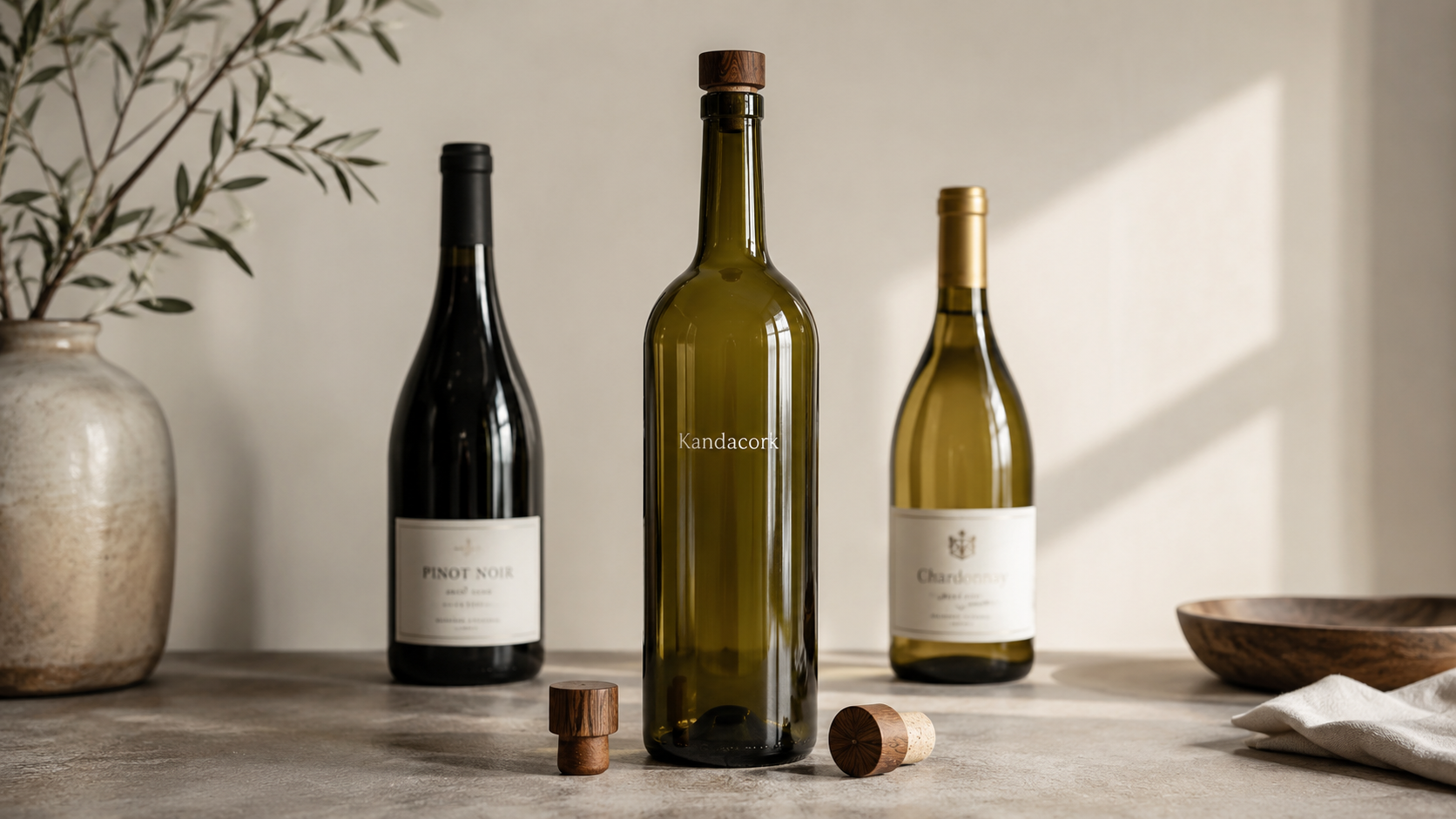
A wooden stopper cork insert is the sealing component used under a wooden bottle stopper head for whisky, rum, tequila, gin, brandy, liqueur, olive oil, vinegar, and specialty beverage bottles. It controls bottle-neck fit, leakage resistance, pull-out feel, reusability, and the consumer’s first opening experience. Kandacork Glass supplies custom wooden bottle stoppers with natural cork, micro-agglomerated cork, synthetic inserts, logo engraving, color finishing, and bottle fitment support.
For premium spirits packaging, the stopper is not only a decorative accessory. It is a functional closure system that must match the glass bottle neck, filling process, product positioning, and brand identity. A well-designed stopper can improve shelf appeal, strengthen brand recognition, and reduce closure-related quality risks before bulk production.
Google recommends creating helpful content for people rather than content made primarily to manipulate rankings, which is why this guide focuses on practical sourcing, material selection, and fitment questions that packaging buyers ask before ordering custom closures. Brands that need a visual starting point can review Kandacork’s custom wooden stoppers for premium spirits bottles to compare wood shapes, shank options, and branding possibilities.
Quick Answer: What Is a Wooden Stopper Cork Insert?
A wooden stopper cork insert is the sealing shank attached below a wooden bottle stopper head. It fits into the bottle neck to create closure pressure, reduce leakage risk, and support repeated opening and closing. For spirits bottles, the correct insert depends on bottle neck bore, cork insert diameter, material compression, insertion depth, pull-out force, and brand presentation.
Wooden Stopper Cork Insert Specifications
| Specification | Options / Notes |
|---|---|
| Stopper Type | Wooden bar-top stopper, T-top stopper, wooden bottle stopper |
| Main Components | Wooden head + cork insert / cork shank / sealing stem |
| Insert Material | Natural cork, micro-agglomerated cork, synthetic cork, hybrid insert |
| Wooden Head Material | Beech, birch, oak, walnut, stained wood, painted wood, wood-metal composite |
| Insert Diameter | Customized according to bottle neck bore and sample test |
| Insert Shape | Straight, tapered, stepped, or custom profile |
| Decoration | Laser engraving, hot stamping, logo printing, staining, coating |
| Applications | Whisky, rum, tequila, gin, vodka, brandy, cognac, liqueur, olive oil |
| Key Tests | Pull-out force, leakage, inversion, transport stability, visual inspection |
| Custom Support | Bottle drawing review, sample development, bulk production support |
What Is a Wooden Stopper Cork Insert?
A wooden stopper cork insert is the part of the bottle stopper that enters the bottle neck. The wooden head gives the closure a premium appearance and comfortable grip, while the insert creates the seal.
In the packaging industry, buyers may use several related terms:
- Cork insert
- Cork shank
- Cork stem
- Cork plug
- Bar-top cork
- T-top stopper
- Wooden bottle closure
- Wooden head cork stopper
- Wooden bar-top cork
- Custom cork shank for whisky bottle
These terms are often used differently by bottle manufacturers, spirits brands, closure suppliers, and packaging distributors. In most sourcing conversations, the key question is the same: will the insert fit the bottle neck correctly and perform reliably after filling, transport, opening, and reclosure?
A wooden bottle stopper is popular in spirits packaging because it creates a more premium opening ritual than a standard screw cap. The consumer sees the wooden head, touches the surface, pulls the stopper, feels the resistance, hears the release, and replaces the closure after pouring. This small interaction can make whisky, rum, gin, tequila, and liqueur packaging feel more valuable.
Why Cork Insert Fit Matters for Spirits Bottles
Fitment is the most important technical factor when choosing a wooden stopper cork insert. A stopper that is too loose may cause leakage, weak reclosure, poor shelf confidence, or inconsistent consumer experience. A stopper that is too tight may be difficult to insert, difficult to remove, or unsuitable for automatic or semi-automatic bottling lines.
The final fit depends on several variables:
- Bottle neck inner diameter
- Neck finish tolerance
- Insert diameter
- Insert taper
- Insert length
- Insertion depth
- Material compression
- Pull-out force
- Filling-line pressure
- Storage temperature
- Transport vibration
- Repeated opening and closing cycles
Cork is widely used in closure applications because it is lightweight, elastic, compressible, and resistant to liquids and gases. The Portuguese Cork Association explains these intrinsic properties of cork, including lightness, impermeability, elasticity, and compressibility, which are highly relevant to cork-based closure performance.
However, material quality alone is not enough. A high-quality cork insert can still fail if the insert diameter, taper, or compression does not match the glass bottle neck. Kandacork Glass recommends testing wooden stopper samples with real glass bottles before bulk production, because actual bottle samples reveal tolerance, surface, and insertion behavior more clearly than drawings alone.
Common Cork Insert Sizes and Bottle Neck Compatibility
There is no universal size for every wooden stopper cork insert. Spirits bottles vary by neck bore, glass tolerance, neck height, bottle style, and desired opening feel. Common market sizes for wooden bar-top corks and T-top stoppers may fall around 18 mm, 19 mm, 19.5 mm, 19.75 mm, 22.5 mm, and 22.6 mm, but these sizes should be treated only as reference points.
| Bottle Situation | Insert Selection Focus | Fitment Notes |
|---|---|---|
| Premium whisky bottle | Natural look, secure seal, premium pull-out feel | Natural cork or micro-agglomerated cork may be suitable |
| Craft gin bottle | Clean appearance, color matching, repeatable opening | Synthetic or micro-agglomerated insert may improve consistency |
| Heavy tequila bottle | Strong stopper presence and firm closure | Larger wooden head and stable insert may be needed |
| Rum or brandy bottle | Warm material feel and classic presentation | Wood finish and cork grade should match brand positioning |
| Olive oil or vinegar bottle | Reclosing performance and food-contact suitability | Insert material and coating should be reviewed carefully |
| Limited-edition spirits bottle | Luxury appearance and collectible value | Custom wood, engraving, metal decoration, and gift-box matching work well |
The safest approach is to send the bottle drawing and physical bottle samples to the stopper supplier. Buyers comparing closure formats can also use Kandacork’s liquor bottle stopper guide for types and sizes to understand how different stopper structures relate to bottle neck selection.
Natural Cork vs Micro-Agglomerated vs Synthetic Cork Inserts
The best insert material depends on the brand, budget, production volume, target market, and packaging performance requirements.
| Insert Material | Main Advantage | Best For | Key Consideration |
|---|---|---|---|
| Natural Cork | Traditional look and premium natural feel | Whisky, brandy, cognac, rum, limited editions | Natural variation should be controlled by grade selection |
| Micro-Agglomerated Cork | More uniform structure and controlled performance | Mid-to-premium spirits and larger production runs | Appearance is more engineered than natural cork |
| Synthetic Cork | Dimensional consistency and repeatable fit | High-volume spirits, modern gin, vodka, private label | Material suitability should match product and market requirements |
| Hybrid Insert | Custom balance of appearance and performance | Special bottle necks or brand-specific projects | Requires sample testing and technical confirmation |
Natural cork is often selected for heritage-style spirits because it communicates authenticity and tradition. Micro-agglomerated cork offers a more controlled structure, making it useful when dimensional consistency matters. Synthetic cork can be a practical option for high-volume production where repeatability, appearance consistency, and bottling-line stability are key priorities.
For food and beverage packaging, buyers should confirm material suitability for the target market and intended conditions of use. In the United States, the FDA provides an inventory of food contact substances listed in 21 CFR, which can help packaging teams understand the regulatory context for materials, coatings, adhesives, and polymers used in food-contact applications.
Wooden Head Materials for Premium Bottle Stoppers
The wooden head gives the closure its visual identity. It influences shelf impact, hand feel, logo decoration, and perceived product value.
| Wood Type | Visual Style | Suitable Packaging |
|---|---|---|
| Beech | Light color, smooth texture, fine grain | Whisky, gin, vodka, rum, large custom projects |
| Birch | Light tone and clean appearance | Modern spirits and minimalist packaging |
| Oak | Stronger grain and classic character | Whisky, bourbon, brandy, premium rum |
| Walnut | Dark, rich, luxury appearance | Limited-edition spirits and gift packaging |
| Stained Wood | Controlled color and brand matching | Black, brown, red, or custom-color closures |
| Wood-Metal Composite | Heavier and more luxurious feel | Flagship spirits and high-end gift bottles |
The wooden head can be customized with laser engraving, side engraving, hot stamping, pad printing, matte coating, gloss coating, color staining, decorative grooves, metal top discs, embossed details, or debossed brand marks.
For luxury spirits, the stopper should match the complete packaging system. A walnut stopper may suit a limited-edition rum, while a light beechwood stopper may fit a craft gin or modern whisky. A black-stained cylindrical stopper can create a clean premium look for vodka, tequila, or private-label spirits.
Custom Branding Options for Wooden Bottle Stoppers
A custom wooden stopper cork insert is both a closure and a brand signal. Consumers often touch the stopper before reading the back label, so the closure should feel stable, intentional, and consistent with the bottle design.
Kandacork Glass can support:
- Logo laser engraving on the top surface
- Side engraving around the wooden head
- Hot-stamped metallic logo
- Black, brown, natural, or custom stained finish
- Printed brand mark
- Decorative edge profile
- Matte or glossy coating
- Wood-metal composite design
- Matching stopper, glass bottle, and gift-box packaging
A craft whisky brand may choose a domed beechwood stopper with a natural cork insert and engraved logo. A modern gin brand may prefer a black-stained cylindrical stopper with a synthetic insert for consistent production. A limited-edition tequila brand may use walnut, metal detailing, and a heavier stopper shape to communicate luxury.
Common Fitment Problems and How to Avoid Them
A stopper may look correct in photos but still fail in real use. The following issues are common when buyers order wooden stoppers without proper fitment testing.
| Problem | Possible Cause | How to Avoid It |
|---|---|---|
| Stopper feels loose | Insert diameter is too small or compression is insufficient | Test multiple insert diameters with real bottle samples |
| Stopper is hard to remove | Insert diameter is too large or material is too stiff | Adjust diameter, taper, material, or insertion depth |
| Leakage during transport | Poor seal, incorrect fit, or unstable compression | Run leakage, inversion, and vibration tests before bulk order |
| Wooden head separates from insert | Weak bonding or unsuitable adhesive control | Confirm adhesion strength and production QC process |
| Uneven pull-out feel | Insert material or bottle tolerance varies | Use controlled insert material and inspect bottle neck consistency |
| Poor logo appearance | Wood grain, coating, or engraving setting is not optimized | Test engraving on the selected wood and finish |
| Color inconsistency | Natural wood variation or unstable staining process | Set visual tolerance and approve production samples |
Kandacork Glass recommends confirming the stopper structure before mass production. Sample testing helps reduce bottling-line delays, rejected closures, leakage complaints, and inconsistent consumer experience. Buyers developing a full closure program can compare related options through Kandacork’s bottle stopper and closure manufacturer page before finalizing the stopper system.
Wooden Stopper Cork Insert Buyer’s Checklist
Before requesting a quotation, buyers can use this checklist to prepare the right information.
| Buyer Question | Why It Matters |
|---|---|
| What is the bottle neck inner diameter? | Determines insert size and compression |
| Do you have a bottle drawing? | Helps review neck finish, tolerance, and insertion depth |
| Can you provide physical bottle samples? | Allows real fitment and pull-out testing |
| Is the bottle for whisky, rum, gin, tequila, or another product? | Helps choose insert material and stopper style |
| Will the stopper be opened repeatedly? | Affects pull-out force and material selection |
| Is the project for premium retail, private label, or gift packaging? | Affects wood choice, finish, and decoration |
| Do you need logo engraving or hot stamping? | Affects wood surface, coating, and artwork preparation |
| Is the product exported? | May require extra packaging and compliance review |
| What is the expected order quantity? | Helps confirm tooling, sampling, and bulk production planning |
This checklist helps the supplier respond faster and reduces the risk of choosing a stopper only by appearance.
Fitment Testing and Quality Control Before Bulk Production
Quality control for a wooden stopper cork insert should cover both appearance and function. A premium closure must look attractive, fit the bottle correctly, and perform reliably during distribution and use.
Recommended QC checkpoints include:
- Bottle neck measurement
- Insert diameter inspection
- Insert length and taper check
- Wooden head diameter and height inspection
- Adhesion strength between wooden head and insert
- Pull-out force evaluation
- Leakage test
- Inversion test
- Transport stability test
- Logo engraving inspection
- Wood finish and color inspection
- Carton and packaging protection review
For distilled spirits sold in the United States, brands should coordinate packaging and labeling with applicable Alcohol and Tobacco Tax and Trade Bureau requirements. TTB’s distilled spirits labeling guidance explains that distilled spirits must be properly labeled before sale in the U.S. marketplace, which is why closure, bottle, and label decisions should be planned together.
For international beverage projects, food-contact documentation may also matter. Buyers should discuss the intended market, filling product, compliance expectations, and documentation requirements before confirming insert materials, adhesives, coatings, and decorative finishes.
Applications for Spirits, Olive Oil, and Specialty Beverage Bottles
A wooden stopper cork insert is widely used in premium and craft packaging because it balances sealing function with brand experience.
Common applications include:
- Whisky bottles
- Bourbon bottles
- Rum bottles
- Tequila bottles
- Gin bottles
- Vodka bottles
- Brandy bottles
- Cognac bottles
- Liqueur bottles
- Olive oil bottles
- Vinegar bottles
- Specialty beverage bottles
- Gift packaging
- Limited-edition packaging
For spirits brands, the stopper is part of the drinking ritual. A well-designed wooden stopper can create a stronger sense of quality than a basic closure. It also gives brands more room for visual customization, including logo engraving, wood staining, metal decoration, and coordinated packaging design. For inspiration on how closures and bottle structures can work together, see Kandacork’s custom whiskey bottle and closure packaging case study.
Why Choose Kandacork Glass for Wooden Stopper Cork Inserts?
Kandacork Glass supports B2B buyers who need custom bottle packaging, not just standard off-the-shelf closures. For spirits brands, packaging distributors, private-label projects, and premium beverage companies, we help coordinate the wooden stopper with the glass bottle, neck finish, brand design, and target market.
Kandacork Glass can support:
- Custom wooden stopper head design
- Natural cork, micro-agglomerated cork, and synthetic insert options
- Bottle neck drawing review
- Physical bottle sample fitment testing
- Logo engraving and hot stamping
- Wood color matching and surface finishing
- Stopper sample development before bulk production
- Wholesale wooden bottle stoppers for B2B projects
- Bulk supply for spirits and specialty beverage packaging
- Matching glass bottle and stopper packaging solutions
Our goal is simple: help your closure look premium, fit correctly, and perform reliably from filling line to final consumer.
How to Order Custom Wooden Stopper Cork Inserts
To develop a custom wooden stopper cork insert, buyers should prepare the right technical and branding information before sampling.
Useful information includes:
- Bottle drawing
- Bottle neck inner diameter
- Physical bottle sample
- Target product type
- Filling volume
- Expected order quantity
- Preferred stopper shape
- Preferred wood material
- Preferred insert material
- Logo artwork
- Target market
- Compliance or documentation requirements
- Packaging and carton requirements
The development process usually includes design selection, insert material confirmation, sample production, fitment testing, logo review, pre-production approval, and bulk manufacturing. For new bottle projects, Kandacork Glass recommends developing the glass bottle and stopper together so the neck finish and closure are matched from the beginning.
For EU-oriented projects, packaging teams should also consider the European Commission’s food contact materials legislation, which explains the general safety and inertness principles behind the EU food-contact framework. Once the technical and branding details are ready, buyers can submit project information through Kandacork’s custom spirits bottle, closure, and decoration inquiry page.
FAQ
What is a wooden stopper cork insert?
A wooden stopper cork insert is the sealing part attached below a wooden bottle stopper head. It fits into the bottle neck and helps create closure pressure. It may also be called a cork shank, cork stem, cork plug, bar-top cork, or T-top stopper.
How do I choose the right cork insert size?
Start with the bottle neck inner diameter, neck finish drawing, and real bottle samples. The correct insert size depends on compression, cork material, insertion depth, pull-out force, and bottle neck tolerance.
Is natural cork better than synthetic cork?
Natural cork is often preferred for premium and traditional spirits packaging because it offers a classic natural appearance. Synthetic cork may be better for projects that require highly consistent dimensions and repeatable production performance.
Can a wooden stopper cork insert be customized?
Yes. The insert material, insert diameter, insert length, wooden head shape, wood type, color, logo engraving, hot stamping, coating, and surface finish can be customized according to bottle and brand requirements.
Which wood is best for a wooden bottle stopper?
Beech is widely used because it has a smooth texture, clean appearance, and good machining performance. Oak, walnut, birch, stained wood, and wood-metal composite options can also be selected for different brand styles.
Are wooden stopper cork inserts suitable for whisky bottles?
Yes. Wooden stopper cork inserts are suitable for whisky bottles, especially when the brand wants a premium appearance, reusable closure, and strong opening experience. Fitment testing is recommended before bulk production.
Can Kandacork Glass make a stopper based on my bottle sample?
Yes. You can send bottle drawings or physical bottle samples. Kandacork Glass can review the bottle neck, recommend insert options, produce samples, and support fitment testing before bulk production.
Can I customize the logo and wood color?
Yes. Common customization methods include laser engraving, hot stamping, logo printing, natural wood finish, black staining, brown staining, custom color matching, matte coating, and glossy coating.
Why should I test samples before bulk production?
Sample testing helps confirm fit, pull-out force, leakage resistance, visual finish, logo quality, and compatibility with the bottle neck. It reduces the risk of production issues and after-sale leakage complaints.
What information should I send for a quotation?
Send the bottle drawing, bottle sample if available, neck inner diameter, expected quantity, stopper style, insert material preference, wood color, logo artwork, target market, and any compliance requirements.


