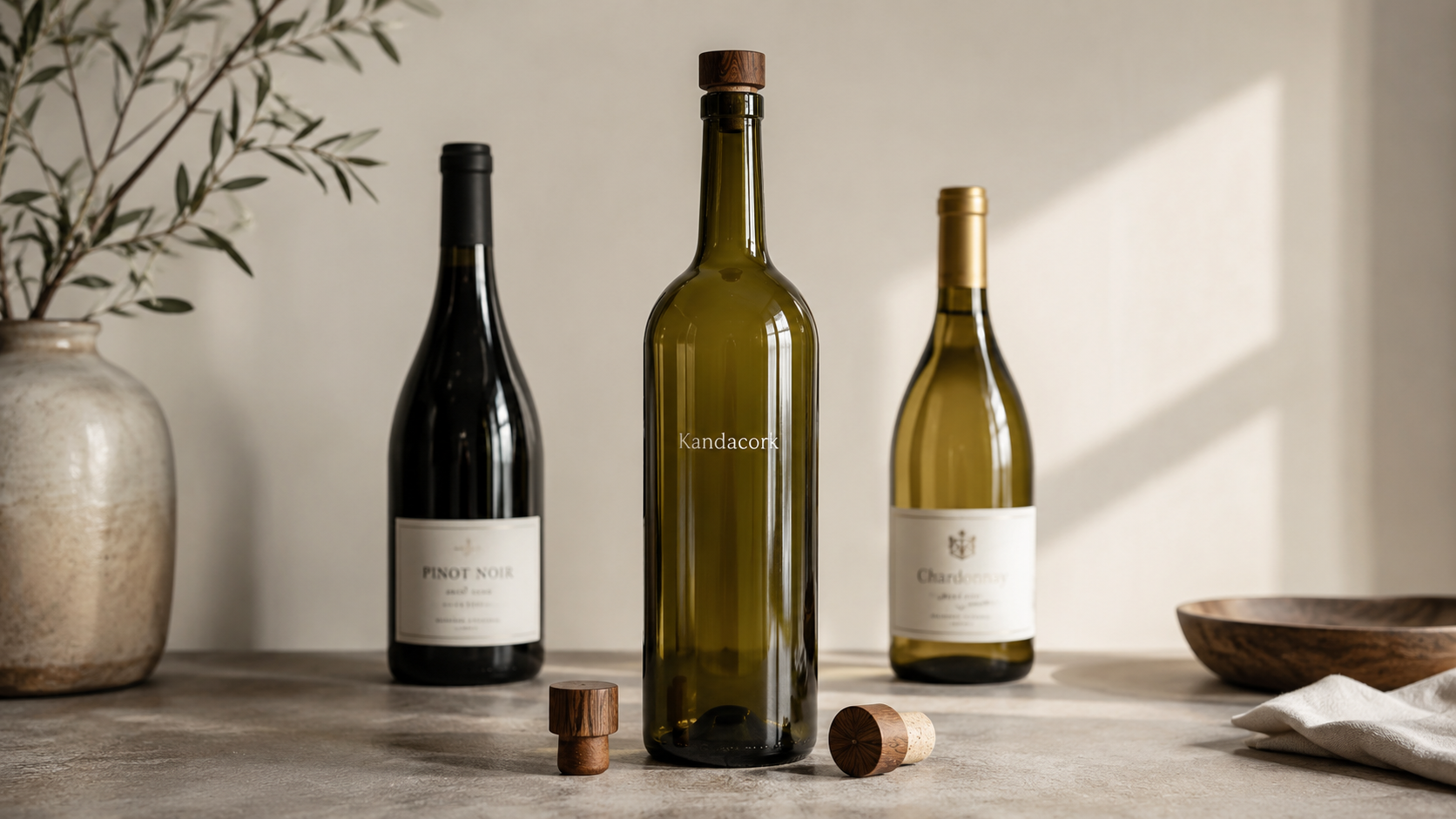
Liqueur bottle closure matching is the process of selecting a cork, screw cap, ROPP closure, stopper, liner, capsule, or tamper-evident system that works with the bottle neck finish, liquid type, filling line, export route, and brand positioning.
For liqueur brands, the wrong closure can create leakage, poor resealing, sticky residue around the neck, cap damage, slow production, or delayed launch approvals. A premium bottle also loses value if the closure feels loose, looks mismatched, or fails during transportation.
As an integrated spirits packaging supplier, Kandacork Glass supports custom glass bottles, matching closures, decoration, and export packaging as one coordinated system. This guide follows the same user-focused logic recommended by Google Search Central’s guidance on helpful, reliable, people-first content: answer real buyer questions clearly, provide practical expertise, and help readers make better decisions.
Key Takeaways
- Bar-top corks are often suitable for premium, giftable, craft, fruit, and herbal liqueur bottles.
- Screw caps are practical for cream liqueurs, mini bottles, coffee liqueurs, chocolate liqueurs, and products that require convenient resealing.
- ROPP closures are useful for tamper-evident, retail-ready, export-oriented, and high-speed filling programs.
- Closure matching must confirm the bottle neck finish, internal bore, liner, cork shank, torque, capping method, and export packing.
- Samples should be tested before bulk production to reduce leakage, cap damage, poor opening feel, and launch delays.
Quick Answer
The best closure for a liqueur bottle depends on the product type, bottle neck finish, filling method, target market, and brand positioning.
Premium fruit, herbal, botanical, and gift liqueurs often use bar-top corks, wood stoppers, aluminum stoppers, or decorative capsules. Cream liqueurs, coffee liqueurs, mini bottles, and RTD-style liqueurs often use screw caps or ROPP closures for better resealability, controlled capping, and tamper-evident performance.
A successful liqueur bottle closure matching process should confirm the internal bore, external neck finish, cap or cork dimensions, liner material, torque or pull-out force, filling-line compatibility, leakage risk, and export packing requirements before bulk production.
Who This Guide Is For
This guide is written for liqueur brands, spirits importers, packaging buyers, private-label alcohol companies, contract fillers, product developers, and purchasing teams that need to match glass liqueur bottles with the correct cork, cap, stopper, sleeve, or ROPP closure.
It is especially useful for buyers developing premium liqueur bottles, cream liqueur packaging, fruit liqueur bottles, herbal liqueur bottles, mini liqueur bottles, RTD cocktail bottles, gift-set spirits packaging, private-label liqueur packaging, and custom glass liqueur bottles with matching closures.
Liqueur Bottle Closure Selection Summary
| Buyer Situation | Recommended Closure Direction | Main Reason |
|---|---|---|
| Premium gift liqueur | Bar-top cork with capsule | Strong shelf appeal and premium opening feel |
| Fruit liqueur | Bar-top cork, screw cap, or aluminum stopper | Depends on brand positioning and resealing needs |
| Cream liqueur | Screw cap or ROPP closure | Better liner control and resealability |
| Herbal liqueur | Bar-top cork, ROPP, or non-refillable closure | Supports premium image or market security |
| Coffee or chocolate liqueur | Screw cap or bar-top stopper | Convenient repeated opening and closing |
| Mini liqueur bottle | Small screw cap or ROPP cap | Efficient filling and retail practicality |
| RTD cocktail bottle | ROPP or screw cap | Suitable for capping speed and tamper evidence |
| Anti-counterfeit market | Non-refillable closure | Helps protect product authenticity |
Why Closure Matching Matters for Liqueur Bottles
Liqueurs are different from many standard distilled spirits because they often contain sugar, flavor extracts, cream bases, fruit ingredients, coffee notes, botanicals, colorants, or higher-viscosity formulations. These characteristics can affect how the liquid behaves around the bottle neck, liner, cork shank, and cap.
A closure that works well for vodka or whiskey may not automatically work for a sweet liqueur, cream liqueur, or RTD cocktail. Sugar residue can affect neck cleanliness. Viscosity can influence pouring and resealing. Chilled display can create condensation around the cap, capsule, and label area.
Good liqueur bottle closure matching prevents common packaging problems such as leakage, cap back-off, sticky neck finish, poor pull-out feel, torn tamper bands, liner failure, scratched decoration, and damaged closures during long-distance shipping.
Glass remains a preferred material for many spirits and liqueur bottles because it supports premium appearance, product visibility, decoration flexibility, and strong shelf presence. The Glass Packaging Institute’s facts about glass also highlight glass as nonporous, impermeable, and endlessly recyclable without loss in quality or purity.
Main Closure Options for Liqueur Bottles
Bar-Top Cork Stoppers
A bar-top cork, also called a T-top cork or T-cork stopper, combines a decorative top with a cork or synthetic shank. The top can be made from wood, plastic, aluminum, glass, ceramic, or custom decorative materials. The shank fits into the internal bore of the bottle neck and creates a friction seal.
Bar-top corks are popular for premium liqueur bottles because they create a strong opening experience. They feel reusable, giftable, and traditional. For craft liqueurs, botanical liqueurs, fruit liqueurs, amaro-style products, and limited-edition spirits, this closure style can communicate quality before the consumer reads the label.
Bar-top cork matching depends heavily on bore diameter, cork shank size, cork compressibility, insertion depth, and pull-out force. The stopper should feel secure but not overly difficult to remove. It should sit straight, align visually with the bottle, and maintain sealing performance during storage and shipping.
For a deeper technical breakdown of T-top materials, sizing, compliance, and fit control, see Kandacork’s spirits bottle stoppers technical buyer’s guide.
Best uses:
- Premium liqueur bottles
- Gift packaging
- Craft spirits brands
- Herbal and fruit liqueurs
- Limited-edition packaging
- Products where opening feel matters
Key checks:
- Internal bore diameter
- Cork shank diameter
- Insertion depth
- Pull-out force
- Stopper seating height
- Leakage after transportation
- Compatibility with capsule or shrink sleeve
Screw Caps and Continuous Thread Closures
Screw caps are practical for liqueur products that require convenience, resealability, and consistent production. They are often used for cream liqueurs, coffee liqueurs, chocolate liqueurs, mini liqueur bottles, and high-volume retail programs.
For screw-cap packaging, the bottle neck finish and closure finish must match. A closure does not fit simply because the diameter looks similar. The thread profile, sealing land, liner contact area, cap depth, and tamper-evident band must all be compatible.
A screw cap can support strong commercial performance when the correct liner, torque, and capping method are selected. This makes it a good option for brands that prioritize user convenience, cost control, and consistent filling-line operation.
Best uses:
- Cream liqueurs
- Coffee liqueurs
- Chocolate liqueurs
- Mini bottles
- High-volume retail liqueurs
- Private-label programs
- Products requiring frequent resealing
Key checks:
- Thread finish compatibility
- Cap diameter and height
- Liner material
- Application torque
- Removal torque
- Cap back-off risk
- Tamper-evident band function
ROPP Closures
ROPP means roll-on pilfer-proof. A ROPP closure is usually an aluminum cap applied to a compatible bottle neck finish. During capping, the closure is rolled onto the neck to form threads and a tamper-evident band.
ROPP closures are useful for liqueur brands that need tamper evidence, retail security, high-speed capping, and a clean aluminum finish. They are common in spirits, wine, RTD beverages, and export-oriented alcohol packaging.
For liqueur bottle closure matching, ROPP requires close coordination between the bottle neck finish, closure dimensions, liner, capping head, and production settings. If the neck finish or capping setup is wrong, the closure may not form correctly, the tamper band may fail, or the cap may be difficult to open.
For U.S. distilled spirits and cordials containing distilled spirits, buyers should review TTB guidance on closures on bottles of distilled spirits, because tamper-evident closure requirements may apply.
Best uses:
- RTD cocktail bottles
- Export liqueur programs
- Duty-free and supermarket channels
- Mini and mid-size bottles
- Brands requiring tamper evidence
- High-speed filling lines
Key checks:
- ROPP neck finish geometry
- Aluminum cap specification
- Capping head setup
- Thread formation
- Tamper-band break performance
- Liner compatibility
- Decoration durability
Non-Refillable Closures
Non-refillable closures are used when a brand wants to reduce refilling risk, protect authenticity, or meet local market expectations. They are especially relevant for premium spirits, export markets, and high-value liqueur products.
A non-refillable system is more complex than a standard cap. The buyer should confirm the pouring mechanism, flow rate, tamper-evident function, cap decoration, and compliance expectations before production.
Best uses:
- Premium export liqueurs
- Herbal spirits
- High-value alcohol products
- Markets with counterfeiting concerns
- Brands that want controlled pouring
Key checks:
- Pouring function
- Anti-refill mechanism
- Neck finish compatibility
- Closure height and appearance
- Local market requirements
- Consumer opening experience
Capsules and Shrink Sleeves
Capsules and shrink sleeves are often used with corks, stoppers, screw caps, or other closures to improve appearance and tamper evidence. They may not always be the primary seal, but they are important to the complete packaging system.
For gift liqueurs, a capsule over a bar-top cork can make the bottle feel more finished and premium. For retail products, a tamper-evident shrink sleeve can help communicate safety and protect the neck area.
Best uses:
- Gift packaging
- Premium bottle presentation
- Tamper-evident packaging
- Neck decoration
- Multi-SKU flavor ranges
- Retail-ready spirits packaging
Key checks:
- Sleeve shrink performance
- Capsule fit over closure
- Heat sensitivity
- Label and cap alignment
- Scuff resistance
- Visual consistency after packing
Closure Matching by Bottle Neck Finish
The bottle neck finish is one of the most important technical factors in liqueur bottle closure matching. A closure must match both the internal and external geometry of the bottle neck.
For bar-top corks, the internal bore is the main fit point. For screw caps and ROPP closures, the external neck finish controls compatibility. For tamper-evident sleeves and capsules, the neck profile, shoulder transition, and closure height also affect the final appearance.
Important neck finish factors include:
- Internal bore diameter
- External neck diameter
- Thread profile
- Sealing land
- Bead or tamper-evident area
- Neck height
- Shoulder shape
- Closure seating area
- Glass tolerance range
A buyer should not confirm bulk production based only on photos. Bottle drawings, closure drawings, and physical samples should be reviewed together.
Bar-Top Cork Fit Considerations
For a bar-top cork, the stopper shank must compress correctly inside the bottle bore. If the shank is too small, the stopper may feel loose or leak. If the shank is too large, it may be difficult to insert, sit crooked, or create excessive stress.
The closure should be checked for both function and appearance. A premium liqueur bottle should have a stopper that feels secure, opens smoothly, reseals properly, and sits evenly on the bottle neck.
Recommended checks:
- Measure the bottle bore inner diameter
- Confirm cork or synthetic shank diameter
- Test insertion force
- Test pull-out force
- Check seating height
- Confirm straight alignment
- Test leakage after shaking or inversion
- Test closure performance after temperature change
Screw Cap and ROPP Fit Considerations
For screw caps and ROPP closures, the most important details are thread geometry, sealing land, cap size, liner type, torque, and tamper-evident performance.
A screw cap must engage smoothly with the bottle neck. It should not cross-thread, loosen during transportation, or require excessive force to open. A ROPP closure must form correctly during application and create a reliable tamper-evident band.
Recommended checks:
- Confirm cap and bottle finish compatibility
- Check liner contact area
- Test application torque
- Test removal torque
- Review cap back-off risk
- Confirm tamper-evident band break
- Test capping-line speed
- Inspect finished cap alignment
- Test leakage after simulated shipping
Closure Matching by Liqueur Product Type
| Liqueur Product Type | Recommended Closure | Reason |
|---|---|---|
| Premium fruit liqueur | Bar-top cork or aluminum stopper | Creates a premium and giftable appearance |
| Cream liqueur | Screw cap or ROPP closure | Supports resealing and liner-controlled sealing |
| Herbal liqueur | Bar-top cork, ROPP, or non-refillable cap | Depends on brand story and security needs |
| Coffee liqueur | Screw cap or bar-top stopper | Supports repeated opening and controlled pouring |
| Chocolate liqueur | Screw cap with suitable liner | Helps manage resealing and product residue |
| Mini liqueur bottle | Small screw cap or ROPP closure | Efficient for retail and sample-size formats |
| RTD liqueur cocktail | ROPP or screw cap | Supports speed, tamper evidence, and convenience |
| Gift-set liqueur | Decorative stopper with capsule | Improves unboxing and shelf presentation |
A single liqueur brand may use different closures across different product lines. For example, a premium 700 ml herbal liqueur may use a wood bar-top cork, while a 50 ml mini bottle from the same brand may use a small screw cap or ROPP closure.
For buyers building a premium spirits portfolio beyond liqueur, Kandacork’s brandy and cognac bottle series shows how bottle shape, closure direction, decoration, and export readiness can be planned together for aged-spirit programs.
Branding and Decoration Considerations
The closure strongly affects the way consumers perceive a liqueur bottle. A heavy glass bottle with a wood bar-top cork feels different from a slim bottle with a matte aluminum ROPP cap. Both can be premium, but they communicate different brand stories.
Wood stoppers can suggest craft, heritage, warmth, and natural ingredients. Aluminum closures can communicate modernity, precision, and premium retail quality. Plastic tops may be suitable for cost-sensitive or high-volume programs. Glass, ceramic, or custom-molded tops can support luxury positioning.
Common decoration options include:
- Top logo printing
- Laser engraving
- Embossed or debossed cap top
- Metallic closure finish
- Custom Pantone color matching
- Foil stamping
- Capsule printing
- Neck label integration
- Color-coded closures for flavor ranges
For multi-flavor liqueur ranges, brands can use one glass bottle shape with different cap colors, labels, sleeves, or stopper materials. This helps reduce mold cost while creating clear shelf differentiation.
Practical Sample Approval Workflow
For custom liqueur bottle projects, Kandacork Glass recommends reviewing the bottle and closure as one packaging system before bulk production.
The process should begin with the bottle drawing and neck finish. After that, the closure drawing, physical bottle sample, closure sample, hand-fit test, capping test, leakage test, decoration check, carton fit, and export packing review should be completed.
This workflow helps identify problems before mold confirmation, closure production, decoration, or large-volume shipping. It is especially important for custom liqueur bottle closures, multi-SKU flavor ranges, and export spirits packaging.
Recommended approval steps:
- Review bottle capacity, shape, and neck finish
- Confirm closure type and material
- Match cork shank, cap size, liner, or ROPP specification
- Test physical bottle and closure samples
- Check visual alignment and seating height
- Test leakage and resealing performance
- Confirm capping method and filling-line compatibility
- Review decoration durability
- Check carton, divider, and pallet protection
- Approve final sample before bulk production
Manufacturer Insight for Better Closure Matching
From a manufacturing perspective, liqueur bottle closure matching should begin before the bottle mold, cap order, or decoration process is finalized. A small mismatch in neck finish, cork size, liner selection, or cap height can create expensive problems during production.
Kandacork Glass reviews bottle and closure compatibility as a complete packaging system. This includes the bottle body, neck finish, closure type, decorative parts, tamper-evident feature, label position, gift box, carton packing, and export logistics.
Many closure issues happen because buyers only send a bottle photo or general capacity request. For accurate closure matching, technical information is much more useful than photos alone. A neck finish drawing, bore measurement, closure sample, filling method, and target market can help the supplier recommend a more reliable solution.
Common Closure Problems and Solutions
| Problem | Likely Cause | Recommended Solution |
|---|---|---|
| Stopper feels loose | Cork shank is too small or bore tolerance is too wide | Test larger shank size and confirm bore range |
| Stopper is hard to insert | Shank is too large or cork is too rigid | Adjust shank diameter or material compressibility |
| Cap leaks after shipping | Poor liner contact, low torque, or wrong neck finish | Confirm liner, torque, and finish compatibility |
| ROPP band does not break cleanly | Incorrect cap, neck finish, or capping setup | Recheck cap specification and capping head setup |
| Closure looks crooked | Poor seating, uneven bore, or capping misalignment | Test sample batches and inspect tooling alignment |
| Capsule wrinkles | Wrong capsule size or poor heat-shrink control | Adjust capsule size and shrink tunnel settings |
| Cap decoration scratches | Weak coating or poor packing protection | Improve coating durability and carton protection |
| Product leaves sticky neck residue | High sugar content or filling splash | Improve filling accuracy and neck cleaning process |
Testing Before Bulk Production
A closure that works in a hand sample may not perform the same way on a filling line. Testing should simulate the real production and distribution environment as closely as possible.
For bar-top corks, testing should include insertion force, pull-out force, resealing, inversion, and storage performance. For screw caps, testing should include application torque, removal torque, liner compression, and cap back-off. For ROPP closures, testing should include capping head setup, thread formation, tamper-band performance, and openability.
Recommended testing areas:
- Fit test
- Leak test
- Inversion test
- Temperature-change test
- Capping-line trial
- Drop or vibration simulation
- Carton compression check
- Export packing review
- Appearance inspection after transport simulation
The ASTM D4169 performance testing standard is often referenced by packaging professionals when evaluating whether shipping units can withstand distribution conditions. For spirits packaging, this is especially useful when decorated glass bottles, capsules, stoppers, and export cartons must perform together.
Kandacork’s own quality control standards for spirits glass bottles and closures explain why dimensional fit, sealing performance, leak testing, torque, extraction force, and user experience should be evaluated as one complete bottle-closure system.
Liqueur Bottle Closure Glossary
| Term | Meaning |
|---|---|
| Bar-top cork | A closure with a decorative top and cork or synthetic shank |
| Internal bore | The inside opening of the bottle neck |
| Neck finish | The shaped bottle neck structure that determines closure compatibility |
| ROPP closure | A roll-on pilfer-proof aluminum closure with tamper-evident function |
| Liner | The sealing material inside a screw cap or ROPP closure |
| Pull-out force | The force required to remove a cork or stopper from the bottle |
| Application torque | The force used to apply a screw cap during capping |
| Removal torque | The force required for the consumer to open the cap |
| Sealing land | The surface area where the closure liner contacts the bottle |
| Tamper-evident band | A closure feature that shows whether a bottle has been opened |
| Non-refillable closure | A closure designed to reduce refilling or product substitution risk |
| Closure fit test | A test that confirms whether the selected closure seals correctly on the selected bottle |
Information to Prepare Before Requesting a Quote
A clear technical request helps the supplier recommend the right bottle and closure faster. Buyers should provide as much information as possible before asking for a quotation.
Useful information includes:
- Bottle capacity
- Bottle shape preference
- Product type and viscosity
- Alcohol content range
- Target closure style
- Current bottle drawing, if available
- Neck finish requirement
- Filling and capping method
- Tamper-evident requirement
- Decoration requirement
- Label or sleeve plan
- Gift box requirement
- Target order quantity
- Export destination
- Required documents or testing standards
For custom liqueur bottle projects, this information allows Kandacork Glass to evaluate the bottle, closure, decoration, and export packaging together rather than treating each component separately.
How Kandacork Glass Supports Liqueur Bottle Closure Matching
Kandacork Glass supports liqueur and spirits brands with custom glass bottles, stock bottle selection, closure matching, decoration, and export packaging coordination.
The goal is to help buyers avoid compatibility problems before production begins. Instead of selecting a glass bottle first and searching for a closure later, Kandacork Glass helps coordinate the neck finish, cap, stopper, capsule, decoration, carton, and logistics plan as one system.
Support can include:
- Stock liqueur bottle sourcing
- Custom glass bottle mold development
- Bar-top cork and stopper matching
- Screw cap and ROPP closure matching
- Tamper-evident sleeve or capsule options
- Decoration coordination
- Sample approval support
- Export carton and pallet planning
- Multi-SKU packaging development
This is especially useful for private-label spirits, premium liqueur brands, gift packaging programs, and importers that need a reliable glass bottle supplier with matching closure support.
FAQ
What is liqueur bottle closure matching?
Liqueur bottle closure matching is the process of selecting and validating the correct cork, cap, stopper, liner, capsule, or tamper-evident closure for a specific glass liqueur bottle. It considers the bottle neck finish, internal bore, seal method, liquid type, filling line, brand appearance, and export requirements.
What is the best closure for premium liqueur bottles?
The best closure for premium liqueur bottles is often a bar-top cork, wood stopper, aluminum stopper, or decorative closure with a capsule. These closures improve shelf appeal and opening experience, but they must be matched to the bottle bore and tested for leakage before production.
Are screw caps suitable for liqueur bottles?
Yes. Screw caps are suitable for many liqueur bottles, especially cream liqueurs, coffee liqueurs, mini bottles, and RTD-style products. The bottle neck finish, liner, torque, and tamper-evident requirement must be matched correctly.
What is the difference between a bar-top cork and a ROPP closure?
A bar-top cork seals by compression inside the bottle bore, while a ROPP closure is an aluminum cap rolled onto a compatible bottle neck finish. Bar-top corks are often used for premium feel, while ROPP closures are often used for production consistency and tamper evidence.
What size cork do I need for a liqueur bottle?
The correct cork size depends on the internal bore diameter of the bottle neck and the compressibility of the cork or synthetic shank. Buyers should test physical samples instead of relying only on nominal dimensions.
Can the same closure be used for different liqueur bottle sizes?
Sometimes, but only if the bottles share the same compatible neck finish or bore specification. Different capacities can use the same closure system, but each bottle should still be tested for fit, leakage, and visual alignment.
Is a tamper-evident closure required for liqueur bottles?
Tamper-evident requirements depend on the target market and product category. For distilled spirits and liqueurs sold in regulated markets, buyers should review local alcohol packaging rules and confirm requirements before production.
How do I prevent liqueur bottle leakage?
Prevent leakage by confirming the bottle neck finish, closure size, cork shank or liner, torque or insertion force, capping method, and export packing. Samples should be tested with the real product or a close product simulation before bulk production.
What should I send to a supplier before ordering custom liqueur bottle closures?
Send the bottle capacity, bottle drawing, neck finish, liqueur type, viscosity, closure style, filling method, tamper-evident requirement, decoration plan, order quantity, and export destination. This helps the supplier recommend a compatible closure system.
Can Kandacork Glass supply both liqueur bottles and matching closures?
Yes. Kandacork Glass can support custom glass liqueur bottles, stock bottles, bar-top corks, screw caps, ROPP closures, tamper-evident sleeves, decoration, and export packaging.