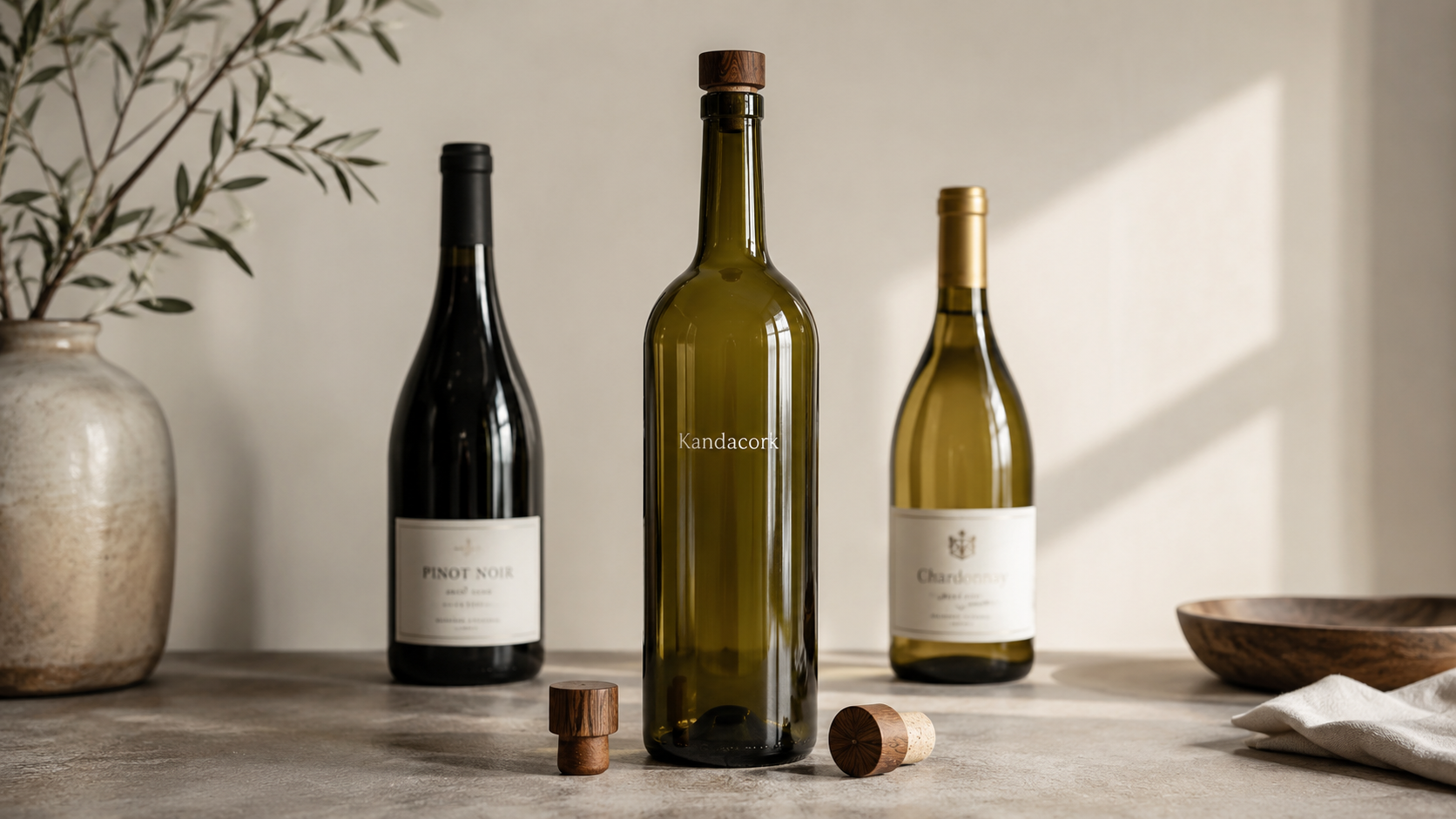
Liquor brand packaging development is the process of turning a spirits brand idea into a complete shelf-ready packaging system. It includes the glass bottle, closure, stopper, label area, decoration, tamper-evident feature, carton, gift box, export packaging, and production approval process.
For whiskey, vodka, gin, rum, tequila, brandy, liqueurs, and RTD spirits, packaging is more than appearance. It affects shelf impact, perceived value, filling-line compatibility, compliance readability, breakage risk, reorder consistency, and buyer confidence.
Kandacork Glass supports liquor brand packaging development as an integrated spirits packaging supplier for global brand owners, bottlers, importers, and private-label programs. The company coordinates spirits bottles, closures, stoppers, decoration, eco glass options, and export-ready production so every packaging component works together before mass production begins.
Planning a spirits packaging project? Send Kandacork Glass your spirit category, bottle capacity, target market, closure preference, decoration idea, estimated order quantity, and launch timeline. The team can recommend a standard, semi-custom, or fully custom packaging route based on your brand goals and production needs.
Liquor Brand Packaging Development Defined
Liquor brand packaging development is the complete technical and creative workflow behind a market-ready spirits package. It connects brand strategy with physical packaging execution.
A complete development process usually includes bottle selection, custom mold planning, neck finish confirmation, closure matching, label panel design, bottle decoration, regulatory label space, carton structure, sampling, mass production, inspection, and logistics.
The main goal is to create packaging that looks distinctive, protects the product, supports required label information, and can be manufactured repeatedly at scale.
For a premium whiskey, the development focus may be heavy-bottom glass, a strong shoulder profile, an embossed brand mark, and a wood or synthetic cork stopper. For a vodka or gin brand, the focus may be high-clarity glass, screen printing, frosting, color contrast, and a clean modern closure. For a private-label liquor project, the priority may be speed, MOQ flexibility, and stable repeat production.
Brand Positioning Before Bottle Design
A spirits package should not begin with decoration alone. It should begin with brand positioning.
Before choosing a bottle, the brand team should define the spirit category, target consumer, price tier, sales channel, launch market, and long-term SKU plan. These decisions influence the bottle shape, glass weight, decoration method, closure style, carton design, and shipping cost.
A premium tequila package may need a sculptural bottle and tactile stopper. A craft gin may need botanical color cues and a clear label hierarchy. A duty-free whiskey gift pack may need a rigid box, stronger outer carton, and highly consistent decoration. A private-label RTD spirits bottle may need fast availability, lower unit cost, and efficient capping.
Retail readiness also matters. If the product will enter supermarkets, liquor stores, duty-free channels, or distributor systems, the packaging plan should leave space for barcodes, batch codes, import stickers, and logistics labels. The GS1 barcode standards are useful for understanding how barcodes support product identification, scanning, and supply-chain movement.
A strong packaging brief should include:
- Spirit category and ABV range
- Target market and sales channel
- Bottle capacity, such as 50 ml, 200 ml, 375 ml, 500 ml, 700 ml, 750 ml, or 1 L
- Price tier and competitor reference brands
- Preferred bottle style, weight, and color
- Closure type and tamper-evident requirement
- Decoration method and visual direction
- Estimated order quantity and annual volume
- Launch timeline and reorder plan
- Destination country and export requirements
This brief helps the supplier recommend the right development route instead of simply quoting a random bottle.
Custom Spirits Bottle Selection
The bottle is the most important physical asset in liquor brand packaging development. It communicates category, quality, and price before the consumer reads the label.
Brands usually choose from three bottle routes: standard bottle, semi-custom bottle, or fully custom bottle.
| Bottle Route | Best For | Main Advantages | Key Considerations |
|---|---|---|---|
| Standard spirits bottle | Fast launch, private label, market testing | Lower development risk, shorter lead time, proven filling-line behavior | Less exclusive visual identity |
| Semi-custom bottle | Growing brands, premium SKUs, limited editions | Better differentiation through decoration, closure, or minor design adaptation | Requires sample testing and decoration approval |
| Fully custom bottle | Signature brand launch, luxury spirits, long-term brand platform | Unique silhouette, custom embossing, stronger brand ownership | Higher mold cost, longer sampling cycle, higher MOQ |
The correct bottle route depends on volume, timeline, budget, and brand ambition. A startup brand may begin with standard spirits bottle options and custom decoration. A mature brand may invest in a custom mold to create a signature silhouette.
Important technical points include neck finish, bottle height, body diameter, label panel flatness, shoulder radius, base thickness, glass distribution, fill point, weight tolerance, and carton fit. A visually attractive bottle can still cause problems if it is unstable on the filling line, difficult to label, or too heavy for export shipping.
Need help choosing the right bottle route? Kandacork Glass can compare standard, semi-custom, and fully custom bottle options based on your launch timeline, order volume, decoration plan, and target price tier.
Glass Material and Packaging Performance
Glass remains one of the most important materials in premium liquor packaging because it supports clarity, weight, product protection, decoration compatibility, and strong shelf presentation. However, the best glass bottle is not always the heaviest bottle. The right structure should match the product category, shipping route, filling conditions, and retail positioning.
A luxury whiskey bottle may need a heavier base and deeper punt to create a premium hand feel. A high-volume vodka or RTD bottle may need better pallet efficiency, lower shipping weight, and stable conveyor performance. A tequila or mezcal bottle may need a distinctive silhouette while still protecting stress points around the shoulder, heel, and neck finish.
Sustainability also starts with material decisions. The Glass Packaging Institute notes in its facts about glass recycling that glass can be recycled repeatedly without loss of quality or purity, which makes recycled-content planning relevant for spirits brands that want lower-impact packaging without giving up premium presentation.
Closure and Stopper System Development
Closures are both functional and emotional. They seal the product, protect the contents, support tamper evidence, and shape the opening experience.
Common liquor closure options include wooden stoppers, synthetic cork stoppers, aluminum stoppers, glass stoppers, metal stoppers, screw caps, ROPP closures, non-refillable closures, capsules, and shrink sleeves. Kandacork Glass provides custom closures and stoppers for spirits bottles, specialty bottles, premium gift packaging, and export programs.
| Closure Type | Common Use | Brand Impression | Technical Focus |
|---|---|---|---|
| Wooden stopper | Whiskey, rum, tequila, gin | Natural, premium, craft | Shank fit, cork quality, top finish |
| Synthetic cork stopper | Spirits and liqueurs | Consistent, practical, export-friendly | Sealing stability, extraction force |
| Aluminum stopper | Vodka, gin, modern spirits | Clean, precise, contemporary | Thread fit, finish consistency |
| Glass stopper | Luxury spirits, limited editions | Elegant, collectible | Fit tolerance, breakage control |
| ROPP closure | High-volume spirits | Efficient, tamper-evident | Torque, capping-line compatibility |
| Non-refillable closure | Premium export markets | Anti-refill, brand protection | Flow control, regulatory fit |
| Capsule or shrink sleeve | Neck finishing and tamper evidence | Finished, secure, premium | Heat application, size matching |
The bottle and closure should be developed together. Neck finish, bore diameter, cork shank, liner, cap height, torque, capsule size, and filling-line equipment must be checked before mass production.
A premium bottle with a weak closure feels incomplete. A strong closure on the wrong neck finish may leak, loosen, or create opening problems. Closure compatibility testing should be part of every serious liquor brand packaging development project.
Decoration and Labeling Strategy
Decoration transforms a glass container into a brand asset. It can make a standard bottle feel premium or make a custom bottle more recognizable.
Common decoration methods include pressure-sensitive labels, transparent labels, screen printing, frosting, spray coating, gradient coating, hot foil stamping, embossing, debossing, decals, UV printing, metallic effects, capsules, and neck labels.
Kandacork Glass supports bottle decoration and branding services for spirits brands that need frosting, coatings, screen printing, transfers, hot foil accents, embossed details, debossed details, metallization, badges, and neck decoration.
Decoration should support the brand story, not overload the package. A minimalist vodka may need high-clarity glass and precise screen printing. A botanical gin may need color, illustration, and a clear label hierarchy. A premium whiskey may need deep embossing, textured paper, foil stamping, and a heavier closure.
Key decoration decisions include:
- Paper label or direct-to-glass printing
- Matte, gloss, frosted, or metallic finish
- Front label size and back label space
- Embossed or debossed brand mark
- Decoration durability during shipping and handling
- Color matching across multiple production batches
- Compatibility with wet, cold, or high-humidity environments
- Photo performance for e-commerce and social media
Decoration should also leave enough space for mandatory label information. An attractive front panel is not enough if the back label becomes unreadable or difficult to apply.
Shelf Impact and Brand Recognition
Shelf impact is the ability of a package to attract attention, communicate quickly, and remain memorable in a crowded environment.
Liquor bottles compete on retail shelves, back bars, duty-free displays, tasting rooms, online product grids, and distributor catalogs. The package must be recognizable from a distance and understandable at close range.
Strong shelf impact usually comes from a combination of bottle silhouette, glass color, label hierarchy, closure detail, typography, contrast, and tactile finish. A distinctive shape can create recognition, but it must still be practical for filling, packing, palletizing, and shipping.
A strong spirits package should pass these checks:
- The brand name is readable from a normal viewing distance
- The spirit type is easy to identify
- The bottle shape matches the intended price tier
- The closure reinforces the quality message
- The label or decoration does not feel generic
- The package photographs well for online sales
- The SKU family can expand without losing consistency
- The carton and outer packaging protect the bottle during export
The best liquor brand packaging development process balances visual differentiation with production feasibility.
Real-World Packaging Development Scenarios
A new whiskey brand entering retail may start with a heavy-bottom standard bottle, textured paper label, wood bar-top stopper, and premium carton. This route gives the brand a high-quality appearance without the cost and lead time of a fully custom mold.
A craft gin brand may choose a clear bottle with a tall silhouette, botanical label artwork, screen-printed detail, and a colored stopper. The priority is shelf visibility, flavor-family flexibility, and strong e-commerce photography.
A premium tequila brand may invest in a semi-custom or fully custom bottle with thick glass, sculptural shoulders, embossing, and a non-refillable closure for selected export markets. The goal is stronger anti-refill protection, luxury positioning, and back-bar recognition.
A private-label vodka project may prioritize a fast standard bottle, efficient screw or ROPP closure, simple label, and export carton. The main requirement is reliable production, cost control, and repeatable supply.
These scenarios show why liquor brand packaging development should not follow one fixed formula. The best solution depends on market, volume, price tier, compliance requirements, and launch strategy.
Packaging Supplier, Design Agency, and Bottle Manufacturer Roles
A design agency usually focuses on brand identity, label artwork, visual storytelling, and retail presentation. This is valuable, especially for new spirits brands that need positioning and shelf communication.
A bottle manufacturer focuses on glass production, mold control, forming, annealing, dimensional stability, and bottle quality. This is essential for physical production and scale.
An integrated liquor packaging supplier coordinates bottle design, closure matching, decoration feasibility, sampling, cartons, inspection, and export preparation. This role is especially useful when a brand needs one development partner to connect design ideas with manufacturing realities.
Kandacork Glass fits the integrated supplier model because its spirits packaging system covers bottles, closures, stoppers, decoration, quality management, warehousing, and logistics under one coordinated structure.
Compliance Space and Label Readability
Compliance should be considered before final artwork and decoration approval. For the U.S. market, the Alcohol and Tobacco Tax and Trade Bureau provides distilled spirits labeling guidance covering required information such as brand name, class or type designation, alcohol content, health warning statement, name and address, net contents, and country of origin for imports.
This is why bottle shape and label space matter. A curved bottle may look premium but make label application difficult. A narrow back panel may not provide enough readable space. Heavy decoration may reduce contrast or make required information harder to read.
Brands should confirm final requirements with qualified regulatory advisors or local authorities. Packaging suppliers can help plan physical space, label area, and decoration feasibility, but legal compliance remains market-specific.
Sampling and Approval Workflow
Sampling reduces risk before mass production. Renderings and digital mockups are useful, but they cannot fully show bottle weight, opening feel, coating texture, label alignment, color accuracy, or carton strength.
A practical sampling workflow includes:
- Reference bottle review
- 3D drawing or technical drawing confirmation
- Prototype or mold sample
- Closure fit sample
- Decoration sample
- Label application test
- Carton and divider sample
- Drop or transport simulation where required
- Final approval sample
The final approved sample becomes the production benchmark. It should define bottle color, weight range, decoration position, closure fit, carton specification, and acceptable quality limits.
This stage is especially important for custom glass bottle packaging, frosted bottles, metallic decoration, hot stamping, heavy bases, unique neck finishes, and premium gift packaging.
Quality Control and Pre-Shipment Inspection
Quality control should be built into liquor brand packaging development from the beginning. It should not be treated as a final checkpoint only after production is complete.
A quality system should support repeatable processes, documented standards, corrective actions, and continuous improvement. The ISO 9001 quality management standard is widely used as a framework for quality management systems, making it a useful reference point for B2B buyers evaluating production consistency.
For glass bottles, important inspection points include capacity, weight, height, diameter, vertical axis deviation, neck finish, mouth diameter, body defects, glass clarity, color consistency, cracks, stones, bubbles, and surface marks.
For closures and stoppers, inspection should cover dimensions, fit, extraction force, torque performance, sealing behavior, liner condition, material finish, and visual consistency.
For decorated bottles, inspection should review print position, registration, color tolerance, coating adhesion, scratch resistance, alcohol resistance where applicable, foil alignment, emboss/deboss accuracy, and packing protection.
For export packaging, inspection should check carton strength, divider fit, pallet stability, carton marking, loading method, and protection against rubbing or breakage.
Packaging Development Cost Factors
Liquor brand packaging development cost depends on the bottle route, decoration complexity, closure material, sampling needs, order quantity, and shipping plan.
A standard bottle with a simple label usually has the lowest development cost. A semi-custom bottle with screen printing, coating, premium stopper, and gift box has a higher setup cost. A fully custom bottle with exclusive mold, embossing, custom closure, and complex decoration requires more investment but can create stronger long-term brand equity.
Main cost drivers include:
- Bottle mold or existing mold selection
- Glass weight and bottle complexity
- Decoration setup and color count
- Frosting, coating, foil, embossing, or debossing
- Closure material and customization
- Capsule, shrink sleeve, or tamper-evident component
- Gift box or rigid carton structure
- MOQ and production batch size
- Inspection requirements
- Export carton, pallet, and freight plan
For serious buyers, cost should be evaluated as total packaging value, not only unit price. A cheaper bottle that breaks during shipping, leaks after filling, or weakens brand perception can cost more in the long term.
MOQ, Lead Time, and Production Planning
MOQ and lead time vary by bottle type, closure choice, decoration process, and customization level.
Standard bottle projects are usually faster because the mold already exists. Semi-custom projects require more sampling and decoration approval. Fully custom bottle projects need mold design, mold manufacturing, trial production, sample approval, and final mass production.
A realistic production plan should include:
- Brief confirmation
- Packaging recommendation
- Technical drawing
- Sample production
- Sample approval
- Mass production
- Decoration production
- Quality inspection
- Carton packing
- Export loading
- Reorder planning
Brands should avoid setting a launch date based only on label artwork completion. Bottles, closures, decoration, cartons, inspections, and logistics all affect the final delivery timeline.
Preparing a launch calendar? Share your expected launch month, first order quantity, reorder plan, and target shipping destination with Kandacork Glass. The team can help align bottle production, closure supply, decoration, packing, and export timing.
Export-Ready Packaging and Logistics
Export packaging is a critical part of liquor brand packaging development. A premium bottle must survive international shipping, warehouse handling, and local distribution.
Export-ready planning includes inner cartons, dividers, carton compression strength, pallet height, container loading, moisture protection, label marking, and inspection documents. For decorated bottles, the packaging must also protect the finish from scratching, rubbing, and pressure marks.
Important export packaging considerations include:
- Bottle-to-bottle separation
- Carton strength and flute type
- Pallet stability
- Container loading efficiency
- Moisture and temperature exposure
- Scratch prevention for coated bottles
- Drop resistance for e-commerce or parcel channels
- Documentation for customs and import handling
A bottle that looks excellent in the sample room must also perform in shipping. This is why packaging development should include both aesthetic design and logistics planning.
Sustainable Spirits Packaging Options
Sustainability is increasingly important in spirits packaging, but claims should be specific and verifiable. Vague phrases such as “eco-friendly” are less useful than clear packaging choices such as recycled glass, lightweight bottle design, optimized carton structure, reduced secondary packaging, or refill-compatible formats where applicable.
For environmental messaging, brands should review the FTC Green Guides before making broad claims about recycled content, recyclability, or eco-friendly packaging. This helps avoid vague language and supports clearer communication with retailers, distributors, and consumers.
Kandacork Glass supports eco and recycled spirits bottle programs for brands that want recycled-content glass, lightweighting discussions, decoration-ready surfaces, closure matching, and export packaging durability.
Sustainable packaging decisions may include:
- Recycled-content glass bottles
- Lightweight bottle engineering
- Reduced oversized gift packaging
- Water-based or lower-impact decoration where suitable
- Carton material optimization
- Pallet and container efficiency
- Refillable or reusable packaging concepts where a refill system exists
- Better durability to reduce breakage and waste
The best sustainability strategy is not always the lightest bottle or the least decoration. It is the packaging system that meets brand, protection, compliance, and logistics needs with the least unnecessary material.
Common Packaging Development Mistakes
Many spirits packaging problems happen because design, engineering, compliance, and production are handled separately.
Common mistakes include:
- Choosing bottle shape before confirming filling-line compatibility
- Selecting a closure without neck finish testing
- Designing labels without checking mandatory information space
- Using decoration that cannot be repeated consistently
- Over-customizing before market validation
- Ignoring carton strength and export breakage risk
- Choosing heavy glass without considering freight cost
- Creating one SKU without planning future flavor or expression extensions
- Approving renderings without physical samples
- Splitting bottle, stopper, label, carton, and logistics across too many uncoordinated suppliers
An integrated packaging partner can reduce these risks by aligning the bottle, closure, decoration, carton, sampling, and export plan before mass production.
Kandacork Glass as a Packaging Development Partner
Kandacork Glass is suitable for spirits brands that need more than a bottle quotation. The company supports custom spirits bottles, closures and stoppers, bottle decoration, recycled glass options, quality management, and global supply-chain coordination.
This integrated model is valuable because liquor brand packaging development usually involves multiple connected decisions. The bottle must fit the closure. The closure must match the brand tier. The decoration must work on the glass surface. The label area must support compliance. The carton must protect the bottle. The production plan must support the launch timeline.
Brands can contact Kandacork Glass with the following information for a more accurate packaging recommendation:
- Spirit category
- Bottle capacity
- Target market
- Reference bottle or mood board
- Preferred closure type
- Decoration requirements
- Estimated order quantity
- Launch timeline
- Shipping destination
- Sustainability requirements
A complete brief helps the supplier recommend whether a standard, semi-custom, or fully custom packaging route is the best fit.
Liquor Brand Packaging Development Checklist
Use this checklist before requesting a quote:
- Spirit type and ABV
- Target market and sales channel
- Bottle capacity and fill volume
- Standard, semi-custom, or custom bottle preference
- Glass color, weight, and shape direction
- Neck finish and closure type
- Tamper-evident or anti-refill requirement
- Label, printing, coating, or decoration method
- Required label space
- Gift box, carton, or shipper requirement
- MOQ and annual volume forecast
- Sample and approval requirements
- Launch date and reorder plan
- Export destination and logistics needs
Ready to develop your spirits packaging? Send Kandacork Glass your bottle capacity, target market, decoration idea, closure preference, order quantity, and launch schedule. The team can help turn your packaging concept into a production-ready bottle, closure, decoration, and export packaging program.
FAQ
What is liquor brand packaging development?
Liquor brand packaging development is the process of designing, testing, producing, and preparing all packaging components for a spirits brand, including the bottle, closure, label, decoration, carton, and export packaging.
Is a custom liquor bottle better than a standard bottle?
A custom liquor bottle is better for long-term brand differentiation, premium positioning, and signature shelf recognition. A standard bottle is better for faster launches, lower development risk, and cost-controlled private-label projects.
How long does liquor packaging development take?
The timeline depends on the bottle route, decoration complexity, closure customization, sampling, and production volume. Standard bottle projects are usually faster, while fully custom bottle projects require more time for mold development, sample approval, production, and export preparation.
What should a brand prepare before requesting a packaging quote?
A brand should prepare the spirit type, bottle capacity, target market, order quantity, closure preference, decoration idea, reference images, launch timeline, and shipping destination.
How much does custom liquor packaging cost?
The cost depends on bottle mold requirements, glass weight, order quantity, closure material, decoration complexity, carton structure, sampling, inspection, and freight. A standard bottle with a label is usually lower cost than a custom-mold bottle with premium decoration and gift packaging.
Why is closure testing important for spirits packaging?
Closure testing confirms that the stopper, cap, cork, liner, or capsule fits the bottle neck correctly. It helps prevent leakage, loose fit, poor opening feel, and filling-line problems.
Should compliance be reviewed before or after packaging design?
Compliance should be reviewed before final artwork and production approval. Required label information needs readable space, correct placement, and compatibility with the bottle shape and decoration method.