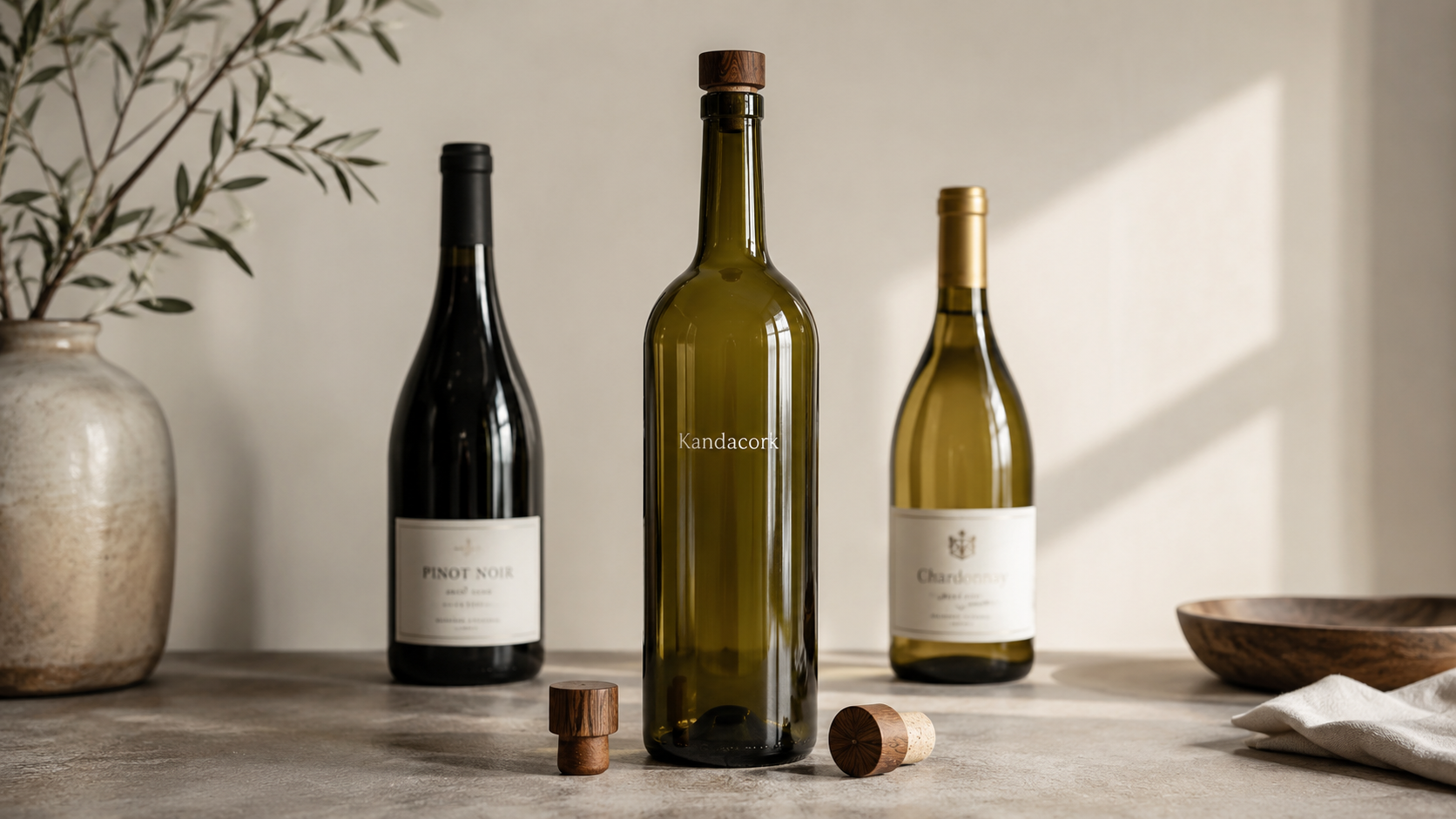
If you are sourcing wooden stoppers for whisky, rum, gin, tequila, vodka, brandy, cognac, or liqueur bottles, the first question is not only how the stopper looks. The key question is whether the wooden stopper fitment matches your bottle neck, shank material, bottling method, and export packaging requirements.
A wooden stopper is both a branding component and a functional closure. It must seal the bottle securely, match the neck finish, perform well during filling, and create a premium opening experience for the consumer.
Kandacork Glass supplies custom wooden bottle stoppers and wooden bar-top closures for spirits brands, glass bottle distributors, packaging companies, and private-label projects. This guide explains how to evaluate bottle neck size, shank diameter, shank material, fitment testing, and custom branding before confirming bulk production.
Quick Answer: What Is Wooden Stopper Fitment?
Wooden stopper fitment means matching the stopper shank diameter, length, material, and compression to the bottle neck inner diameter. For many spirits bottles, a shank slightly larger than the neck opening is tested first, but final approval should always be based on real bottle samples, leakage checks, pull-out force testing, and bottling-line trials.
A reliable stopper fit should feel firm when inserted, smooth when opened, and stable after repeated reclosing. The goal is not only to make the stopper fit once, but to make it perform consistently across production bottles, shipping conditions, and consumer use.
What Is Wooden Stopper Fitment?
Wooden stopper fitment is the process of matching a wooden bottle stopper to the technical and visual requirements of a glass bottle. It combines packaging design, closure engineering, material selection, dimensional tolerance control, and practical testing.
A wooden stopper usually includes three core parts:
| Component | Function | Fitment Impact |
|---|---|---|
| Wooden head | Visible top used for grip, branding, and decoration | Affects appearance, handling, shelf impact, and premium feel |
| Shank or insert | Cork, micro-agglomerated cork, synthetic, or elastomer section inserted into the neck | Controls sealing, compression, insertion force, and pull-out force |
| Bottle neck finish | Glass opening and neck geometry | Determines closure compatibility, seating position, and leakage risk |
The wooden head creates the brand image. The shank creates the mechanical seal. The bottle neck determines whether the closure can perform correctly.
This is especially important because glass packaging is not only a container choice but also part of a broader quality, sustainability, and circular packaging system supported by the North American glass container industry. For spirits brands, the stopper and the bottle should be engineered as one packaging system rather than treated as two separate components.
Why Wooden Stopper Fitment Matters for Spirits Bottles
For premium spirits, the closure is part of the product experience. When a consumer opens a bottle of whisky, tequila, rum, gin, or brandy, the stopper is often the first physical touchpoint with the brand.
A correct wooden stopper fitment helps deliver:
- Secure sealing during storage and transport
- Consistent opening and reclosing experience
- Reduced leakage and return risk
- Better bottling-line efficiency
- Premium shelf appearance
- Compatibility with capsules, shrink sleeves, cartons, and gift boxes
- Stronger perceived value for luxury spirits
Poor fitment creates problems that can damage both product quality and brand reputation. A loose stopper may leak or feel cheap. An oversized stopper may be difficult to insert and unpleasant to open. A stopper that sits crooked can make the entire package look defective.
For B2B buyers, fitment is also a cost-control issue. If stoppers do not match the bottle correctly, the result can be production delays, higher reject rates, repacking costs, distributor complaints, and export shipping damage.
How to Measure Bottle Neck Size for Wooden Stopper Fitment
The first technical step is measuring the bottle neck inner diameter. This is sometimes called the bore, opening, or internal neck diameter. In bottle neck finish terminology, buyers may also see measurements such as the I dimension, which refers to the inside diameter of the bottle neck, and the T dimension, which refers to the outside diameter across the thread or closure finish. Technical references on glass neck finish dimensions explain why the inside opening and neck finish tolerance affect compatibility with inserts, fitments, and closures.
For bar-top spirits bottles, common neck sizes include 18.5 mm and 21.5 mm, but custom bottles may use different dimensions. The stopper should not be selected only by appearance. It should be selected according to the actual neck size and the shank material’s compression behavior.
| Bottle Neck Inner Diameter | Common Shank Size to Test | Typical Application |
|---|---|---|
| 18.5 mm | 19.5 mm | Standard spirits bottles, craft whisky, gin, vodka, rum |
| 21.5 mm | 22.5 mm | Premium spirits bottles, wider-neck bottles, decanter-style packaging |
| Custom neck ID | Custom shank size | Custom glass molds, ceramic bottles, limited-edition packaging |
The common “slightly larger than the neck opening” rule is a useful starting point, but it is not a final specification. Glass bottle tolerance, cork density, synthetic shank hardness, fill conditions, and closure equipment can all affect the final result.
For accurate wooden stopper fitment, buyers should prepare:
- Bottle technical drawing
- Neck inner diameter
- Neck finish tolerance
- Physical bottle samples
- Target spirit type and ABV
- Fill volume
- Bottling method
- Packaging format
- Target order quantity
- Branding artwork or reference design
If the bottle drawing is not available, measure several bottles from the same production batch. Do not rely on one bottle only, because glass tolerances can vary between molds, batches, and suppliers. For brands developing both bottle and closure together, Kandacork Glass can coordinate custom spirits glass bottles with matching bar-top closures to reduce compatibility risk from the beginning.
Wooden Stopper Shank Size: Diameter, Length, and Taper
The shank is the part that enters the bottle neck. It is the most important functional element in wooden stopper fitment because it determines sealing strength, insertion force, pull-out force, and leakage performance.
Shank Diameter
Shank diameter controls how tightly the stopper fits inside the bottle neck. If the shank is too small, the stopper may feel loose or leak. If the shank is too large, it may be hard to insert, deform the cork, stress the glass, or create an unpleasant opening experience.
For many bar-top closures, a 19.5 mm shank is commonly tested with an 18.5 mm bottle neck, while a 22.5 mm shank is commonly tested with a 21.5 mm bottle neck. Final approval should always be based on real bottle testing.
Shank Length
Shank length affects how much contact area the stopper has inside the bottle neck. A longer shank may improve stability and sealing surface, but it must not bottom out or interfere with the liquid level.
A suitable shank length should:
- Provide enough sealing contact
- Keep the stopper stable
- Allow clean seating on the bottle top
- Avoid unwanted contact with the liquid
- Work with capsules, shrink sleeves, cartons, and gift boxes
Straight Shank vs Tapered Shank
Straight shanks can provide consistent insertion behavior, especially when using synthetic materials. Tapered cork shanks can create gradual compression and may be useful for certain bottle neck designs.
The best choice depends on bottle geometry, closure material, target pull-out force, and production method.
| Fitment Factor | Too Small | Too Large | Correct Fit |
|---|---|---|---|
| Shank diameter | Loose feel, leakage risk, weak pull-out force | Hard insertion, cork damage, excessive compression | Firm friction fit and reliable seal |
| Shank length | Poor stability, limited sealing area | Bottoming out, poor seating, packaging interference | Stable seal and clean stopper position |
| Head diameter | Weak shelf impact, poor grip | Visual imbalance, carton or capsule interference | Balanced premium appearance |
| Pull-out force | Feels cheap or insecure | Difficult to open | Controlled premium opening feel |
| Compression | Insufficient seal | Excessive stress | Consistent closure performance |
Best Shank Materials for Wooden Bottle Stopper Fitment
Different shank materials behave differently during insertion, storage, transport, and repeated opening. Choosing the right material is essential for custom wooden bottle stoppers.
| Shank Material | Best For | Main Advantage | Watch Point |
|---|---|---|---|
| Natural cork | Heritage spirits, craft whisky, premium rum, traditional liquor packaging | Natural appearance and classic opening feel | More natural variation in density and compression |
| Micro-agglomerated cork | Premium brands needing cork appearance with better consistency | Balanced cork look and improved dimensional control | Supplier quality and bonding consistency matter |
| Synthetic shank | High-volume spirits, export packaging, automated filling lines | Stable fitment, repeatable compression, and consistent pull-out force | Less natural material story than cork |
| Elastomer or custom insert | Special bottle necks, design-led projects, technical closures | Customizable sealing behavior | Requires careful compatibility testing |
Natural Cork Shank
Natural cork is often used for traditional spirits, craft brands, heritage packaging, and premium bottle concepts. It offers a natural appearance and a classic closure feel.
Natural cork is suitable when the brand wants:
- Traditional spirits packaging appeal
- Natural material positioning
- Premium visual authenticity
- A classic cork opening experience
Natural cork may show more variation than synthetic materials. For bulk orders, cork grade, diameter tolerance, moisture condition, and visual quality should be controlled carefully.
Micro-Agglomerated Cork Shank
Micro-agglomerated cork provides a more uniform cork-based option. It is made from cork particles formed into a consistent structure, giving better dimensional control than many natural cork shanks.
Micro-agglomerated cork is suitable when the project needs:
- Cork-based appearance
- Improved consistency
- Better batch-to-batch control
- Stable compression
- Balanced cost and performance
For many spirits brands, micro-agglomerated cork offers a practical balance between natural appearance and industrial reliability.
Synthetic Shank
Synthetic shanks are widely used for wooden bar-top closures because they offer strong dimensional consistency and predictable compression behavior.
Synthetic shanks are suitable when the buyer needs:
- Consistent fitment across large production runs
- Stable insertion force
- Repeatable pull-out force
- Lower variation between batches
- Better compatibility with automatic or semi-automatic bottling lines
- Reliable performance for export packaging
For projects where repeatability matters more than a natural cork story, Kandacork Glass also supplies synthetic cork stoppers for spirits bottles that support stable neck fit, controlled compression, and consistent appearance across production runs.
Wooden Stopper Fitment for Whisky, Gin, Rum, and Tequila Bottles
Different spirits categories often require different visual styles, but the technical fitment process is similar. Bottle neck inner diameter, shank size, material compression, and closure compatibility should always be confirmed before bulk production.
Whisky Bottle Stoppers
Whisky brands often prefer natural wood heads, dark stains, cork-based shanks, and a traditional opening feel. For premium whisky and single malt packaging, the stopper should feel solid, controlled, and consistent. A loose stopper can make the product feel lower in value, while an overly tight stopper can hurt the consumer experience.
Gin and Vodka Bottle Stoppers
Gin and vodka brands may prefer clean, modern stopper designs with painted wood, light wood, logo engraving, or color-matched caps. For these products, visual consistency and clean seating are important because bottle designs are often transparent, minimal, or label-focused.
Rum and Brandy Bottle Stoppers
Rum and brandy packaging often uses warm wood tones, dark finishes, and heavier bottle shapes. A slightly larger wooden head may enhance shelf impact, but the closure must still fit cartons, gift boxes, and export packaging.
Tequila and Mezcal Bottle Stoppers
Tequila and mezcal brands often use bold custom shapes, engraved logos, special finishes, or decorative inserts. These design-led closures require careful wooden stopper fitment testing because unusual head shapes can affect handling, machine insertion, and packaging compatibility.
Across all spirits categories, the best closure is not the most decorative stopper alone. It is the stopper that fits the bottle, supports the brand, and performs reliably from filling line to final consumer use.
How to Match the Wooden Head to Your Bottle Design
After the technical shank is selected, the wooden head should be developed to match the bottle design and brand positioning.
Common wooden stopper head shapes include:
- Cylindrical heads
- Mushroom heads
- Domed heads
- Beveled heads
- Stepped heads
- Spherical heads
- Faceted heads
- Wood-metal composite heads
The head diameter and height should match the bottle shoulder, neck length, label design, capsule style, and outer packaging. A large wooden head can create a premium decanter-style appearance, but it may interfere with cartons or capsules. A smaller head may reduce cost and improve packaging efficiency, but it may not provide enough luxury shelf impact.
Wooden head finishing options may include:
- Natural wood grain
- Dark stain
- Light stain
- Painted finish
- Pantone-matched color
- Laser engraving
- Debossed logo
- Top logo
- Side logo
- Metal insert
- Foil decoration
- Textured grip
For luxury spirits, the stopper should not look like a separate accessory. It should look like part of the complete packaging system, including the glass bottle, label, capsule, closure, and gift box. This is why stopper design should be reviewed together with spirits bottle decoration and branding, including surface finish, logo placement, color direction, metallic details, and secondary packaging.
Wooden Stopper Fitment Checklist for Buyers
The wooden stopper fitment checklist below helps buyers confirm the most important technical details before requesting samples or confirming bulk production.
| Item to Confirm | Why It Matters |
|---|---|
| Bottle neck inner diameter | Determines the starting shank size |
| Neck finish tolerance | Affects fit consistency and leakage risk |
| Bottle drawing | Helps confirm technical compatibility |
| Physical bottle sample | Allows real fitment testing |
| Shank material | Controls compression, sealing, and pull-out force |
| Shank diameter and length | Determines fit tightness and seating position |
| Spirit type and ABV | Helps evaluate material suitability |
| Bottling method | Impacts insertion force and line performance |
| Closure head size | Affects appearance, grip, cartons, and capsules |
| Branding method | Influences MOQ, lead time, and cost |
| Leak test requirement | Reduces shipping risk and customer complaints |
| Order quantity | Helps plan tooling, sampling, and production schedule |
For U.S.-market spirits projects, packaging and fill decisions should also be reviewed with applicable compliance expectations. For example, the TTB explains requirements related to distilled spirits net contents and standard containers, including requirements intended to avoid misleading purchasers through container design or excessive headspace.
Need a fitment sample? Send Kandacork Glass your bottle neck inner diameter, bottle drawing, or physical sample. Our team can recommend wooden head styles, shank materials, and sample dimensions for testing before bulk production.
How Kandacork Glass Reviews Wooden Stopper Fitment
For custom wooden stopper projects, Kandacork Glass reviews the bottle neck inner diameter, bottle drawing, stopper head design, shank material, and expected bottling method before recommending sample dimensions.
When possible, physical bottle samples are used to test:
- Insertion feel
- Seating position
- Pull-out force
- Shank compression
- Leakage risk
- Reclosing performance
- Capsule or carton compatibility
- Visual alignment with the bottle design
For export spirits packaging, Kandacork Glass recommends checking the stopper under upright, tilted, and inverted storage conditions. If the same stopper will be used across multiple bottle molds or suppliers, fitment should be validated with bottles from each source.
This manufacturer-style review helps reduce risk before mold opening, branding approval, and mass production.
How to Test Wooden Stopper Fitment Before Bulk Orders
No wooden stopper should move directly from design approval to mass production without sample testing. Even when the drawing looks correct, real-world fit may change because of bottle tolerance, cork condition, synthetic shank hardness, filling temperature, or production equipment.
Sample Fit Test
Test the stopper with actual production bottles. Insert and remove the stopper several times. Check whether it feels secure, sits straight, and closes smoothly.
Insertion Force Test
The stopper should insert smoothly without excessive pressure. If the stopper requires too much force, the shank may be oversized, too rigid, or unsuitable for the bottle neck.
Pull-Out Force Test
The stopper should feel secure but not difficult to open. A premium spirits bottle should give the consumer a controlled, confident opening experience.
Leak Test
Test the filled bottle in upright, tilted, and inverted positions. For export packaging, also consider vibration, temperature changes, and long-distance transportation. Packaging teams can use ASTM International standards resources when building broader distribution, packaging, or transport-test programs for commercial shipments.
Reclosing Test
Many spirits bottles are opened and closed many times after purchase. The stopper should continue to seal properly after repeated use.
Bottling-Line Trial
For automatic or semi-automatic filling lines, test the stopper with actual equipment. Check for jamming, inconsistent insertion depth, damaged shanks, crooked seating, and reject rates.
A reliable wooden stopper fitment is confirmed through testing, not assumptions. This is especially important for premium liquor bottle packaging, limited-edition spirits, and export orders.
Common Wooden Stopper Fitment Problems and Solutions
Fitment issues are much easier to solve during sampling than after mass production. The table below explains common issues and practical solutions.
| Fitment Issue | Possible Cause | Practical Solution |
|---|---|---|
| Stopper feels loose | Shank too small, neck ID larger than expected, weak material recovery | Increase shank diameter or change shank material |
| Stopper is too tight | Shank oversized, high compression, wrong taper, rigid material | Reduce diameter or adjust material hardness |
| Leakage during transit | Poor compression, short shank, glass tolerance issue | Test longer shank or more stable insert material |
| Stopper sits crooked | Uneven neck finish, poor assembly alignment, shank centering issue | Improve assembly tolerance and inspect bottle neck |
| Cork crumbles | Low cork grade, dry storage, excessive insertion force | Upgrade cork grade or use micro-agglomerated or synthetic shank |
| Line jams | Head geometry or shank tolerance unsuitable for equipment | Run bottling-line trials and adjust stopper design |
| Stopper looks too small | Head diameter not matched to bottle proportions | Increase head diameter or use a stronger premium shape |
| Capsule does not fit | Stopper head too wide or too tall | Check capsule and carton compatibility before production |
For B2B projects, the safest approach is to test several sample options before finalizing the production specification.
Custom Wooden Stopper Development Process
A clear development process helps reduce approval time and avoid costly mistakes.
Share Bottle Details
Provide the bottle drawing, neck inner diameter, neck finish tolerance, bottle sample, target fill volume, and packaging format. If bottles come from more than one supplier, test samples from each source.
Define Product Requirements
Confirm the spirit type, ABV, storage conditions, target market, annual volume, branding style, and any specific compliance or documentation needs. For brands selling into the United States, the official 27 CFR Part 5 distilled spirits regulations are an important reference point for labeling, container, and market-entry requirements.
Select Head and Shank Options
Choose the wooden head shape, wood type, finish, logo method, shank material, shank diameter, and shank length.
Produce Fitment Samples
Start with blank fitment samples if the closure size is uncertain. After the fit is confirmed, move to branded samples with engraving, painting, staining, or decorative inserts.
Test and Adjust
Check insertion force, pull-out force, leakage, reclosing performance, packaging compatibility, and bottling-line behavior. Adjust the shank size, material, head shape, or finish if needed.
Confirm Mass Production Specifications
Before bulk production, confirm drawings, tolerances, color standards, logo placement, packing method, carton quantity, MOQ, lead time, and inspection criteria.
This process is especially important for custom glass bottles, ceramic bottles, decanter-style bottles, luxury spirits, and limited-edition packaging.
Why Choose Kandacork Glass for Custom Wooden Stoppers?
Kandacork Glass supports custom spirits bottle closure projects where the stopper must deliver both premium appearance and reliable performance. For B2B buyers, the goal is not only to buy a wooden cap. The goal is to create a complete packaging solution that fits the bottle, supports the brand, and performs during production and shipping.
Kandacork Glass can support:
- Custom wooden bottle stoppers
- Wooden bar-top closures
- Natural cork, micro-agglomerated cork, and synthetic shank options
- Custom wooden head shapes
- Logo engraving and decorative finishing
- Fitment support based on bottle neck data
- Samples for testing and approval
- Bulk wooden stoppers for spirits brands and distributors
- Packaging coordination with bottles, capsules, labels, and gift boxes
A successful wooden stopper fitment should not be guessed. It should be developed through measurement, material selection, sampling, testing, and production control.
Whether you are developing whisky, rum, gin, tequila, vodka, brandy, cognac, or liqueur packaging, Kandacork Glass can help match the stopper design to the bottle neck and brand identity.
FAQ
What size wooden stopper fits a spirits bottle?
The correct size depends mainly on the bottle neck inner diameter. For many bar-top spirits bottles, a shank slightly larger than the neck opening is tested first to create a firm friction fit. Final approval should always be based on actual bottle samples, leakage testing, and pull-out force checks.
What is the difference between 18.5 mm and 21.5 mm bottle necks?
They are common bar-top neck sizes used for spirits bottles. An 18.5 mm neck often pairs with a 19.5 mm shank for testing, while a 21.5 mm neck often pairs with a 22.5 mm shank. The exact fit depends on bottle tolerance, shank material, and desired opening feel.
Should I choose natural cork or synthetic shank?
Natural cork is suitable for brands that want a traditional premium appearance. Synthetic shanks are better when dimensional consistency, line performance, and repeatable pull-out force are priorities. Micro-agglomerated cork offers a balance between cork-based appearance and improved consistency.
Can Kandacork Glass make custom wooden stoppers for my bottle?
Yes. Kandacork Glass can support custom wooden head shapes, shank materials, logo decoration, finish options, and fitment checks. Buyers can provide a bottle drawing, neck inner diameter, physical bottle sample, spirit type, and branding artwork.
How do I know if a wooden stopper is leakproof?
A wooden stopper should be tested with real production bottles and filled samples. Recommended checks include insertion force, pull-out force, inversion testing, reclosing cycles, temperature exposure, transport simulation, and bottling-line trials.
Is wooden stopper fitment only important for whisky bottles?
No. Wooden stopper fitment is important for whisky, rum, gin, tequila, brandy, cognac, vodka, liqueurs, olive oil, vinegar, and other premium liquid products using bar-top or T-top closures.
What information should I send before requesting wooden stopper samples?
Send the bottle drawing, neck inner diameter, bottle sample if available, target spirit type, ABV, order quantity, preferred wooden head style, logo artwork, and shank material preference. This helps the supplier recommend the right fitment more accurately.