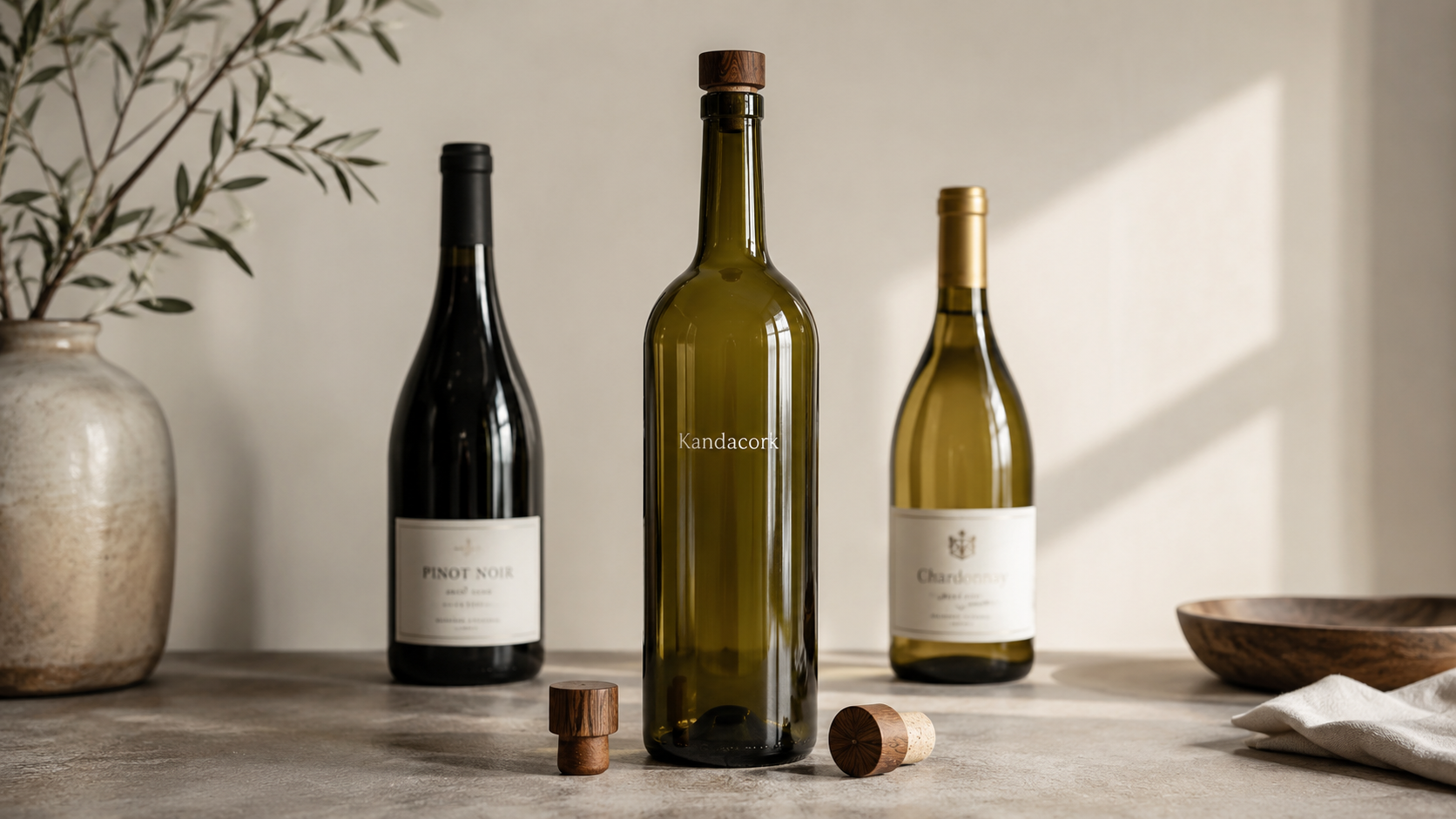
Anti-refill closures for spirits bottles help liquor brands reduce refill fraud, protect premium packaging, and show visible tamper evidence after opening. For whisky, vodka, tequila, rum, gin, brandy, cognac, and liqueur brands, the right non-refillable closure system can combine a one-way pourer insert, tamper-evident cap, custom decoration, and bottle-neck compatibility review.
In the spirits packaging industry, these closure systems are also called non-refillable closures, NRF closures, anti-counterfeit spirits closures, refill-resistant closures, or security closures for liquor bottles. They are designed to allow smooth pouring while making unauthorized refilling difficult after the original bottle has been opened.
For premium and export spirits, the closure is not only a cap. It is part of the brand-protection system, the consumer opening experience, and the overall bottle design. Kandacork Glass supplies custom non-refillable closures for spirits brands that need practical security, premium presentation, and bulk packaging support.
Why Anti-Refill Closures Matter for Spirits Brands
Refill fraud can happen when an empty original bottle is refilled with inferior alcohol and resold as a genuine product. This creates several risks at the same time: brand reputation damage, consumer distrust, channel conflict, and potential safety concerns.
The issue is especially important for premium and export spirits because the bottle itself may carry high perceived value. A heavy glass bottle, embossed logo, decorated cap, luxury label, gift box, and tax-strip-ready neck can all make the empty package attractive for reuse.
Anti-refill closures for spirits bottles help brands:
- Make unauthorized refilling more difficult
- Show visible evidence of opening or tampering
- Support consumer confidence at shelf level
- Reduce packaging vulnerability in hospitality channels
- Protect premium bottle and label investment
- Support distributors in high-risk markets
- Improve export and duty-free packaging security
- Combine security with custom decoration and brand identity
Illicit alcohol and counterfeit products are recognized as serious issues in global trade. The OECD’s work on illicit trade in alcohol highlights counterfeit alcohol, tampering, falsification, and refilling as part of the broader illicit alcohol problem. For spirits brands, a secure closure is one practical layer in a wider protection strategy that may also include controlled supply chains, market monitoring, traceability, and distributor training.
Best Applications for Anti-Refill Closures
Anti-refill closures are most valuable when the product has higher brand value, stronger distribution risk, or a premium package that could be reused by counterfeiters. They are especially useful for spirits brands selling through export markets, duty-free channels, hospitality networks, or regions where refill fraud is a known concern.
| Best For | Why It Matters |
|---|---|
| Premium spirits brands | Helps protect high-value packaging and brand reputation |
| Export liquor projects | Supports channel security and distributor confidence |
| Duty-free spirits | Adds visible tamper evidence for travel retail |
| Private-label liquor | Improves packaging credibility and differentiation |
| Whisky, vodka, tequila, rum, and gin | Matches major spirits bottle closure applications |
| Limited-edition bottles | Reduces the risk of valuable empty bottles being reused |
| Hospitality and bar channels | Helps discourage refilling and bottle substitution |
For lower-risk local products, a simple tamper-evident cap may be enough. For premium spirits, export bottles, or high-value SKUs, a full NRF closure system can provide stronger protection and a better brand experience.
What Are Anti-Refill Closures for Spirits Bottles?
Anti-refill closures for spirits bottles are security closure systems designed to control liquid flow and resist backfilling. A typical structure may include an outer cap, internal pourer insert, one-way valve, sealing liner, tamper-evident band, and decorative branding surface.
When the bottle is tilted, the spirit pours out through the insert. When someone tries to pour liquid back into the bottle, the internal valve, ball, or flow-control structure restricts reverse filling. This helps reduce the risk of a genuine bottle being reused with fake, diluted, or low-quality alcohol.
These closure systems are commonly used for:
- Whisky and single malt
- Vodka and gin
- Tequila and mezcal
- Rum and cane spirits
- Brandy and cognac
- Liqueurs and flavored spirits
- Duty-free and travel retail products
- Premium private-label spirits
- Export liquor brands
- High-risk distribution markets
For B2B buyers, the main purpose is to combine security, sealing performance, appearance, and production compatibility in one closure system.
Ordinary Caps vs Anti-Refill Closures
Many liquor bottles use ordinary screw caps, bar-top stoppers, or tamper-evident caps. These options can seal the bottle and support brand appearance, but they may not prevent refill fraud. Anti-refill closures provide additional protection by adding a refill-resistant internal structure.
| Feature | Ordinary Cap | Anti-Refill Closure |
|---|---|---|
| Basic sealing | Yes | Yes |
| Tamper evidence | Sometimes | Usually |
| Refill resistance | No | Yes |
| Controlled pouring | Limited | Optional |
| One-way insert | No | Usually |
| Premium decoration | Optional | Yes |
| Best use | Low-risk or standard bottles | Premium, export, and refill-risk spirits |
| Brand protection value | Basic | Higher |
In some markets, tamper evidence is also a regulatory consideration. For example, U.S. distilled spirits rules require certain bottles or containers to have a closure or device that must be broken to access the contents, as described in the eCFR section on liquor bottle, label, and closure requirements. Anti-refill closures can add a further security function beyond basic first-opening evidence.
Anti-Refill, Non-Refillable, Tamper-Evident, and Anti-Counterfeit Closures
These terms are often used together, but they describe different functions.
| Term | Meaning | Main Purpose |
|---|---|---|
| Anti-refill closure | A closure designed to resist liquid being poured back into the bottle | Reduce refill fraud |
| Non-refillable closure / NRF closure | Industry term for a closure with anti-refill function | Protect genuine spirits bottles from reuse |
| Tamper-evident closure | A closure that shows visible evidence after first opening or forced removal | Show opening or tampering |
| Anti-counterfeit closure | A closure or packaging system that helps discourage copying or verify authenticity | Support brand protection |
| Smart closure / connected closure | A closure using QR, NFC, serialization, or digital identity tools | Support traceability and consumer engagement |
A premium spirits bottle may use several of these features together. For example, a tequila bottle may use a non-refillable pourer, a tamper-evident aluminum cap, a decorated top disk, and a serialized QR code. A whisky bottle may use an NRF closure with a branded capsule, tax-strip area, and anti-tamper band.
The strongest protection usually comes from a layered system, not a single feature.
How Anti-Refill Closure Systems Work
Anti-refill closures for spirits bottles work by combining controlled pouring with reverse-flow resistance. The exact design depends on the bottle neck, closure type, spirit category, filling line, and security requirement.
A common closure system includes the following components:
| Component | Function | Buyer Consideration |
|---|---|---|
| Outer cap or shell | Provides appearance, grip, decoration, and protection | Material, color, height, finish, logo method |
| Inner fitment or pourer | Controls flow and supports anti-refill function | Neck fit, insert retention, pouring speed |
| One-way valve or ball system | Restricts liquid from flowing back into the bottle | Anti-refill performance and liquid compatibility |
| Sealing liner or gasket | Helps prevent leakage and evaporation | Alcohol resistance and compression performance |
| Tamper-evident band or bridge | Shows first opening or attempted removal | Break behavior and visible evidence |
| Decoration surface | Carries branding and premium appearance | Printing, embossing, foil, texture, color matching |
| Authentication feature | Supports verification and traceability | QR code, NFC, batch code, serialization |
The most important technical factor is compatibility. Even a high-quality NRF cap can perform poorly if the bottle neck finish, inner diameter, sealing surface, capping torque, or filling-line setting is not suitable. Buyers planning a new bottle range should review the closure together with the bottle structure, drawing, decoration zone, and filling process. A clear spirits bottle sourcing process can reduce avoidable revisions before sampling.
Common Specification Options
Specification details depend on the selected closure structure, bottle neck, target spirit category, and custom decoration requirements. However, the following table shows common options used in non-refillable liquor caps and custom spirits bottle closures.
| Specification Item | Common Options |
|---|---|
| Closure material | Aluminum, plastic, aluminum-plastic composite |
| Main function | Anti-refill, non-refillable, tamper-evident, controlled-pour |
| Insert type | One-way pourer, valve insert, ball system, flow-control insert |
| Decoration | Printing, embossing, debossing, hot foil, color coating |
| Finish | Matte, gloss, satin, brushed, metallic, anodized |
| Application | Whisky, vodka, gin, rum, tequila, brandy, cognac, liqueur |
| Packaging type | Bulk cartons, export cartons, custom packing |
| Project type | Standard closure matching or custom development |
| Branding support | Logo printing, top disk, sidewall design, Pantone color matching |
| Testing support | Fit test, leak test, pour test, torque review, line trial |
These specifications should be confirmed before bulk production. A closure that looks correct visually may still require adjustments for fit, sealing, pouring, or capping-line performance.
Recommended Anti-Refill Closure by Spirit Type
Different spirits categories may require different closure structures. The best choice depends on product value, alcohol content, market risk, bottle shape, and brand positioning.
| Spirit Type | Recommended Closure Option | Why It Works |
|---|---|---|
| Whisky / Single Malt | Aluminum-plastic NRF closure | Premium appearance, strong decoration options, reliable tamper evidence |
| Tequila / Mezcal | Non-refillable pourer with branded cap | Protects high-value export bottles and supports controlled pouring |
| Vodka / Gin | ROPP non-refillable closure | Suitable for high-speed bottling and clean visual presentation |
| Rum | Anti-refill cap with tamper-evident band | Useful for refill-risk markets and hospitality channels |
| Brandy / Cognac | Decorative anti-refill closure with premium finish | Supports luxury positioning and authenticity protection |
| Liqueur | Controlled-pour anti-refill insert | Helps manage flow speed and reduce dripping |
| Duty-Free Spirits | NRF closure with visible tamper evidence | Supports distributor and consumer confidence in travel retail |
This table is only a starting point. Before bulk production, the closure should be tested with the actual bottle, actual liquid, and target filling-line conditions.
Common Types of Anti-Refill Closures for Spirits Bottles
Non-Refillable ROPP Closures
ROPP closures are roll-on pilfer-proof aluminum caps formed onto the bottle neck during capping. When combined with an anti-refill insert, they can provide tamper evidence, efficient production, and strong brand presentation.
They are often used for vodka, gin, whisky, rum, brandy, and other high-volume spirits. ROPP systems can support side printing, top printing, embossing, color coating, metallic effects, and custom finishes.
Aluminum-Plastic NRF Closures
Aluminum-plastic NRF closures combine a decorative aluminum shell with internal plastic components. They are common in premium liquor packaging because they offer both appearance and function.
These closures can be customized with matte, gloss, brushed, satin, anodized, or metallic finishes. For premium bottle projects, the cap color and texture can be matched with the bottle glass, label design, gift box, and secondary packaging.
Controlled-Pour Anti-Refill Inserts
Controlled-pour inserts are used when the brand wants smoother serving performance. They help regulate flow speed, reduce dripping, and improve the consumer experience.
This option is useful for tequila, gin, rum, liqueurs, and bar-focused spirits where pouring performance matters. The key is to balance anti-refill resistance with a smooth and natural pour.
Tamper-Evident Anti-Refill Closures
A tamper-evident anti-refill closure combines reverse-flow resistance with visible opening evidence. The tamper feature may be a breakaway band, tear strip, bridge, sleeve, or visible indicator.
This structure is especially useful for spirits sold through duty-free, export, hospitality, and high-risk distribution channels. It helps retailers and consumers quickly identify whether the bottle has been opened or interfered with.
Custom Security Closure Systems
Some premium brands need more than a standard cap. A custom closure system can combine a specific bottle neck, anti-refill insert, branded cap, tamper-evident sleeve, tax-strip area, and optional digital authentication.
This approach is suitable for premium whisky, limited-edition tequila, cognac, rum, craft spirits, and private-label liquor projects that need both luxury design and brand protection.
Closure, Stopper, and Bottle System Planning
Anti-refill performance should not be reviewed in isolation. A secure cap must work with the glass bottle, neck finish, label area, capsule plan, gift box, export carton, and filling line. That is why many professional buyers prefer to discuss custom closures and stoppers at the same time as bottle selection.
A complete spirits packaging review should consider:
- Bottle neck finish and dimensional tolerance
- Cap diameter and height
- Insert depth and retention
- Sealing liner compression
- Pouring speed and drip control
- Tamper-evident break behavior
- Decoration alignment with labels and capsules
- Carton protection and pallet stability
- Filling-line feeding, capping, and inspection
For a spirits-focused packaging project, the closure should feel like part of the brand experience rather than a separate hardware item. Buyers developing whisky, vodka, gin, rum, tequila, or liqueur ranges can also review specialized spirits bottle closure systems when comparing closure formats for different SKUs.
Technical Factors Before Ordering Anti-Refill Closures
Before ordering anti-refill closures for spirits bottles, buyers should confirm technical details rather than focusing only on cap appearance and unit price.
Bottle Neck Finish
The bottle neck controls how the closure fits, seals, opens, and performs. Important dimensions include outer diameter, inner diameter, neck height, bead shape, thread profile, sealing surface, and tolerance range.
Closure Diameter and Height
The closure must match both the technical neck finish and the visual proportion of the bottle. A tall premium bottle may need a taller closure for balance, while a compact bottle may need a shorter cap.
Insert Fit and Retention
The inner insert must stay securely in place during capping, opening, pouring, shipping, and attempted refilling. Poor insert retention can cause leakage, weak anti-refill performance, or poor consumer experience.
Spirit Type and ABV
High-alcohol liquids may interact differently with liners, gaskets, coatings, and plastic components. Whisky, vodka, rum, gin, tequila, brandy, and liqueurs may require different compatibility reviews.
Filling and Capping Line
The closure must match the bottling process. Buyers should consider capping method, line speed, torque range, cap feeding, bottle handling, inspection points, and production tolerance.
Pouring Performance
A secure closure still needs to pour well. Flow rate, dripping, glugging, air return, and consumer opening feel should be tested before mass production.
Export and Storage Conditions
Temperature changes, vibration, humidity, long-distance shipping, container loading, and warehouse storage can affect leakage and closure performance. Export packaging should be considered during closure validation.
Digital Authentication and Anti-Refill Closures
Physical closure security and digital authentication can work together. A non-refillable closure helps protect the bottle physically, while a QR code, NFC tag, batch code, or serialized identifier can support traceability and consumer engagement.
A layered security system may include:
- Anti-refill insert to resist backfilling
- Tamper-evident band to show first opening
- Batch code for production traceability
- QR code for product information
- NFC tag for authentication campaigns
- Tax strip or market-specific compliance label
- Controlled closure supply and packaging records
The GS1 Digital Link standard shows how identifiers such as GTINs, batch numbers, and serial numbers can connect physical packaging to online information. However, digital tools should not replace physical protection. A copied QR code may still appear on counterfeit packaging if the bottle and closure are not secure.
For high-value spirits, the better strategy is layered protection: secure bottle, secure closure, visible tamper evidence, controlled decoration, and traceable product data.
Decoration and Branding Options for NRF Caps
A security closure should still look premium. For many liquor brands, the cap is one of the first elements the consumer touches. It should match the bottle shape, label design, glass color, and brand positioning.
Common branding options include:
- Pantone color matching
- Matte, gloss, satin, brushed, or metallic finishes
- Top printing
- Side printing
- Embossed or debossed logos
- Hot foil details
- Knurled, ribbed, grooved, or smooth sidewalls
- Matching capsules or shrink sleeves
- Coordinated neck labels or tax-strip areas
Kandacork Glass supports bottle decoration and branding for spirits packaging projects where the bottle, closure, and surface finish need to work together. For direct logo application, screen printing for custom spirits bottles can help create durable artwork that aligns with the closure design and overall packaging system.
For brands that need a dedicated decoration pathway, custom spirits bottle decoration and branding can support coating, printing, foil, embossing, debossing, metallization, badges, and other visual identity details.
Sustainability and Material Considerations
Anti-refill closures are usually selected for security and functionality, but material choices still matter. Buyers should consider how the cap, insert, liner, sleeve, and decorative finish affect packaging weight, recyclability, and brand sustainability goals.
Glass remains an important material for premium spirits because it provides strong shelf presence, chemical stability, and high perceived value. The Glass Packaging Institute notes that glass can be recycled repeatedly without loss of quality or purity, although real-world recycling depends on local collection, sorting, color separation, and market infrastructure.
For spirits packaging, practical sustainability discussions often include:
- Avoiding unnecessary over-packaging
- Reviewing glass weight without compromising strength
- Choosing decoration methods that remain production-stable
- Coordinating closure material with actual market recycling systems
- Reducing damage rates through better export packing
- Designing premium packaging that lasts through transport and retail handling
For broader packaging programs beyond spirits, integrated bottle and closure systems can help buyers compare glass, closures, decoration, accessories, and filling-line requirements as one package. Brands with refill, reuse, or lower-impact goals may also evaluate eco and refill packaging design when developing future packaging strategies.
Testing Anti-Refill Closures for Spirits Bottles Before Bulk Production
Testing is essential for custom anti-refill closures for spirits bottles. Sampling should not stop at visual approval. A closure must fit the bottle, seal properly, pour smoothly, and support the required security function.
| Test Item | What to Check | Why It Matters |
|---|---|---|
| Bottle neck measurement | Inner diameter, outer diameter, bead, thread, height, tolerance | Confirms closure compatibility |
| Closure fit test | Cap alignment, insert position, shell fit, neck engagement | Prevents loose fit or assembly issues |
| Leak test | No leakage after inversion or storage simulation | Prevents product loss and carton damage |
| Pour-flow test | Smooth flow without excessive glugging or dripping | Improves consumer experience |
| Insert retention test | Insert remains fixed after opening and handling | Protects anti-refill function |
| Opening torque test | Closure opens within an acceptable consumer range | Avoids poor opening experience |
| Tamper-band test | Band or bridge breaks visibly after first opening | Supports visible tamper evidence |
| Alcohol compatibility review | Liner, plastic, coating, and insert resist spirit contact | Reduces material failure risk |
| Capping-line trial | Closure feeds, caps, and seals consistently | Reduces production risk |
| Transport simulation | Closure and carton remain stable during shipment | Supports export reliability |
For premium spirits or export projects, pre-production testing is strongly recommended. It helps identify issues before the brand commits to full packaging, filling, and market launch. For distribution packaging, test methods such as the ANSI overview of ASTM D5276 drop testing show why real transport handling should be considered when validating cartons and packed goods.
How to Choose Anti-Refill Closures for Spirits Bottles
Choosing anti-refill closures for spirits bottles should start with the bottle, not the cap. The closure must match the neck finish, spirit type, production method, market risk, and consumer experience.
A practical selection process should include:
- Review the bottle drawing or physical sample
- Confirm neck finish dimensions and tolerance
- Define the required security level
- Select the closure structure and insert type
- Check material compatibility with the spirit
- Confirm decoration and brand appearance
- Test fit, sealing, pouring, and anti-refill function
- Validate capping-line performance
- Approve packaging and export requirements
Buyers should also consider the opening ritual. A closure that is difficult to open, pours poorly, or looks inconsistent with the bottle design can damage the brand experience even if it has good security features.
How to Choose the Right Anti-Refill Closure Supplier
The right supplier should provide more than a catalog of caps. For B2B spirits packaging, the supplier should understand bottle compatibility, closure function, decoration, quality control, and export packaging.
When selecting a supplier, evaluate:
| Supplier Capability | Why It Matters |
|---|---|
| Bottle neck engineering support | Reduces mismatch risk between bottle and closure |
| Closure sample testing | Confirms fit, sealing, pouring, and security function |
| Decoration capability | Supports premium brand presentation |
| Insert and pourer compatibility | Helps balance anti-refill function and pouring experience |
| MOQ and production flexibility | Supports both launch orders and repeat supply |
| Spirits packaging experience | Improves project communication and risk control |
| Export packaging knowledge | Reduces damage, leakage, and transport issues |
| Integrated bottle and closure supply | Simplifies coordination and approval |
Kandacork Glass is positioned to support integrated spirits packaging projects, including glass bottles, stoppers, closures, decoration, and bulk supply. This can reduce communication gaps between bottle design and closure performance.
MOQ, Lead Time, and Custom Development
MOQ and lead time depend on closure structure, material, tooling, decoration, color, insert design, and testing requirements. Standard options usually move faster. Fully custom anti-refill closures for spirits bottles require more sampling and validation.
A typical project includes:
- Project brief and target market review
- Bottle drawing or physical sample check
- Closure recommendation
- Sample preparation
- Fit, leakage, pouring, and tamper-evident testing
- Color, logo, and finish confirmation
- Pre-production approval
- Bulk production
- Export packing and delivery
For better project control, buyers should share their annual forecast, first order quantity, target launch date, and whether the same closure will be used for one bottle or multiple SKUs.
What Information to Send for a Fast Quote
To receive an accurate quote, buyers should prepare the following information:
- Bottle drawing or physical bottle sample
- Neck finish dimensions
- Current closure sample, if available
- Spirit type and ABV
- Target market and distribution channel
- Required security level
- Preferred closure material
- Cap diameter and height
- Color and finish requirements
- Logo and decoration method
- Estimated order quantity
- Annual forecast volume
- Filling-line and capping method
- Packaging and delivery requirements
- Tax-strip, sleeve, or compliance requirements
The more complete the project brief, the faster the supplier can recommend a suitable closure structure and reduce unnecessary sampling delays.
Why Choose Kandacork Glass?
Kandacork Glass supports spirits brands with custom glass bottles, closures, stoppers, decoration, and packaging supply. For brands that need anti-refill closures for spirits bottles, this integrated approach can reduce mismatch risk between the bottle, closure, decoration, and production process.
Kandacork Glass can support:
- Custom spirits bottle development
- Standard mold bottle selection
- Non-refillable closure matching
- Anti-refill insert and pourer review
- Tamper-evident closure options
- ROPP and aluminum-plastic closure solutions
- Premium cap decoration
- Bottle and closure appearance matching
- Neck compatibility review
- Sample support before bulk production
- Export-ready packaging supply
For B2B buyers, the main advantage is coordination. Instead of sourcing the bottle from one supplier and the closure from another, brands can review the full packaging system together before mass production.
FAQ
Are anti-refill closures the same as non-refillable closures?
Yes. In most spirits packaging discussions, anti-refill closures and non-refillable closures describe the same general function. Both are designed to make it difficult to refill a used bottle after opening.
Do anti-refill closures completely stop counterfeiting?
No closure can stop every type of counterfeiting by itself. Anti-refill closures reduce refill risk, but brands should combine them with tamper evidence, controlled packaging supply, traceability, market monitoring, and authentication tools.
Can anti-refill closures be used on existing bottles?
Yes, but compatibility must be checked. The bottle neck finish, inner diameter, outer diameter, sealing surface, and capping method determine whether a specific closure can be used.
Are anti-refill closures suitable for whisky, vodka, rum, tequila, and gin?
Yes. Anti-refill closures for spirits bottles are widely used across whisky, vodka, rum, tequila, gin, brandy, cognac, and liqueur packaging. The structure should be selected based on bottle design, alcohol type, market risk, and brand positioning.
Can I customize the color, logo, and finish?
Yes. Common customization options include Pantone color matching, embossing, debossing, top printing, side printing, hot foil, metallic finishes, matte finishes, gloss finishes, and textured sidewalls.
Do anti-refill closures affect pouring performance?
They can, which is why testing is important. A good closure should resist refilling while still providing a smooth, controlled pour. Flow rate, dripping, air return, and opening feel should be checked before mass production.
What is the MOQ for custom anti-refill closures?
MOQ depends on closure type, material, decoration, tooling, and production process. Standard options usually have lower MOQ than fully custom designs. Buyers should send bottle drawings, target quantity, and decoration requirements for a specific quote.
How long does custom development take?
Lead time depends on sampling, tooling, decoration, testing, and order quantity. A simple standard closure project can move faster, while custom anti-refill closures for spirits bottles may require multiple sample rounds and functional validation.
Can anti-refill closures work with tax strips or shrink sleeves?
Yes. Many closure systems can be designed to work with tax strips, shrink sleeves, capsules, or tamper-evident labels. These requirements should be discussed at the beginning of the project.
What should I test before bulk production?
At minimum, test fit, leakage, opening torque, pouring performance, anti-refill function, tamper-evident behavior, insert retention, decoration quality, and filling-line compatibility.
Final Buying Advice
Anti-refill closures for spirits bottles are not only a security upgrade. They are part of the total packaging system that protects the liquid, supports the brand image, and improves buyer confidence in premium liquor products.
The best closure choice depends on the bottle neck, spirit type, target market, security risk, filling line, design goals, and order volume. For premium spirits brands, the smartest approach is to review the bottle and closure together before mass production.
To discuss custom anti-refill closures for spirits bottles, non-refillable cap options, tamper-evident closure systems, decoration choices, and integrated glass bottle packaging support, contact Kandacork Glass with your bottle drawing, closure requirements, target market, and estimated order quantity.